

The “Q-Day” clock is ticking. With the National Institute of Standards and Technology (NIST) officially publishing the first set of post-quantum cryptography (PQC) standards (FIPS 203, 204, and 205) in August 2024, the theoretical threat of quantum computing has shifted into an operational reality.
For CISOs, the challenge is no longer just about “stronger encryption”—it is about crypto-agility. The ability to swap out cryptographic primitives without breaking critical infrastructure is now a survival skill. The threat of “Harvest Now, Decrypt Later” (HNDL) means that data stolen today is already at risk of future decryption.
This guide provides an in-depth analysis of the top 5 post-quantum crypto-agility tools available in 2025. We move beyond buzzwords to evaluate specific features, deployment models, and “best for” use cases to help you secure the “Zero Position” in your industry’s security posture.
The CISO’s New Mandate: Why Crypto-Agility?
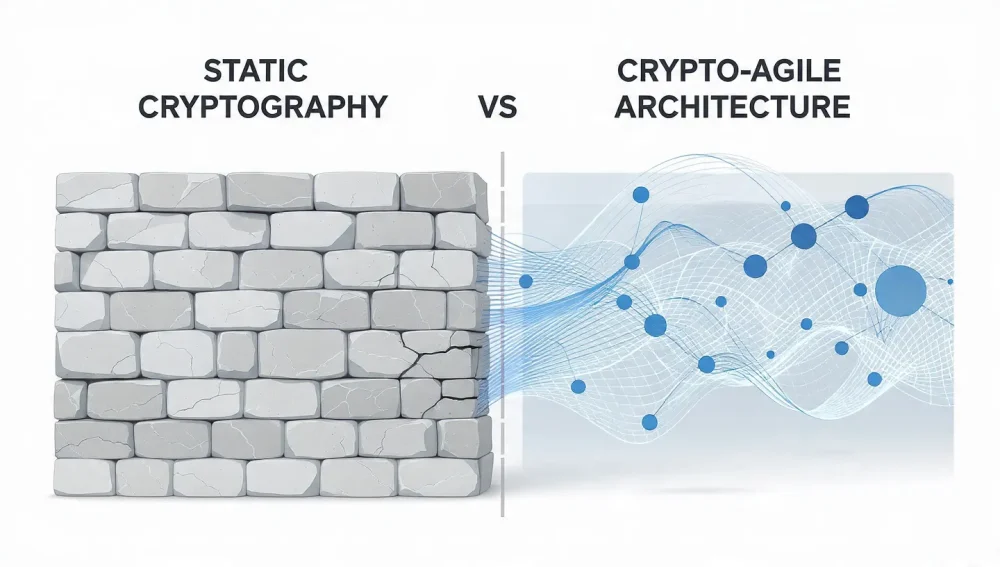
Before diving into the tools, we must define the battlefield. Crypto-agility is the capability of an information system to rapidly change or replace cryptographic algorithms, keys, and protocols without disrupting operations.
In the post-quantum era, static encryption is a vulnerability. You cannot hard-code algorithms anymore. You need a dynamic layer that allows you to:The 7 best AI-powered VPNs that automatically switch protocols to avoid 6G throttling
- Discover every instance of cryptography in your environment (Shadow Crypto).
- Assess which assets are vulnerable to quantum attacks (Shor’s algorithm).
- Migrate to hybrid (classical + PQC) or native PQC standards seamlessly.
The Top 5 Post-Quantum Crypto-Agility Tools
We have evaluated the leading market contenders based on their discovery capabilities, remediation automation, ease of integration, and alignment with NIST standards.
1. SandboxAQ (AQtive Guard)
Best For: Large Enterprises & “Shadow Crypto” Discovery
SandboxAQ, an alphabet spinoff, has rapidly become the heavyweight champion for cryptographic visibility. Their flagship product, AQtive Guard, is designed to solve the “you can’t protect what you can’t see” problem.
Key Features
- Deep Discovery: Scans not just networks but deep into binaries, source code, and third-party libraries to create a comprehensive Cryptographic Bill of Materials (CBOM).
- Risk Assessment: Automatically maps discovered assets against policy violations and quantum vulnerabilities.
- Non-Human Identity (NHI) focus: Excellent at finding hard-coded credentials and machine-to-machine keys that are often overlooked.
CISO’s Verdict
SandboxAQ is the “MRI machine” for your cryptographic health. It doesn’t just skim the surface; it tells you exactly which library in which legacy application is holding you back.Can You Get Rich Off Stocks? Find Out Now!
| Feature | Rating | Notes |
|---|---|---|
| Discovery Depth | ⭐⭐⭐⭐⭐ | Best-in-class binary and code scanning. |
| Automation | ⭐⭐⭐⭐ | Strong policy enforcement; remediation requires integration. |
| Deployment | SaaS/Agent | Scales well for global organizations. |
2. Keyfactor (Command + AgileSec)
Best For: PKI Modernization & Certificate Lifecycle Management
Keyfactor has cemented its position by acquiring InfoSec Global, integrating the powerful AgileSec Analytics into its Keyfactor Command platform. If your organization relies heavily on Public Key Infrastructure (PKI)—and most do—this is your tool.
Key Features
- Complete CLM: Automates the lifecycle of machine identities (issue, renew, revoke) across multi-cloud and on-prem environments.
- AgileSec Analytics: Provides real-time scanning of network traffic and file systems to inventory cryptographic assets.
- Hybrid Roots of Trust: Allows you to issue hybrid certificates (combining RSA/ECC with Dilithium/Kyber) to bridge the transition gap.
CISO’s Verdict
Keyfactor turns the headache of certificate management into a strategic advantage. Its ability to automate the rotation of millions of certificates makes it essential for avoiding outages during the PQC migration.
3. QuSecure (QuProtect)
Best For: Network Layer Protection & Government/DefenseBest Tattoo Fonts And Lettering Generators (2026): Design Your Perfect Ink
QuSecure takes a different approach with QuProtect. Instead of just managing keys, it secures the data in transit via a software-defined cryptographic tunnel. It is particularly favored in government and defense sectors for its focus on immediate remediation.
Key Features
- Quantum-Security-as-a-Service (QSaaS): A software overlay that protects data in transit without requiring you to rip and replace legacy code immediately.
- Orchestration: dynamically negotiates keys and algorithms. If a new vulnerability is found in an algorithm tomorrow, QuProtect can switch to a different one instantly via policy.
- Satellite & Edge Ready: Optimized for low-bandwidth and high-latency environments (IoT, space, tactical edge).
CISO’s Verdict
If you need to stop the bleeding of “Harvest Now, Decrypt Later” today, QuProtect acts as a quantum-resistant tourniquet. It buys you time to fix the underlying applications while securing the network pipe immediately.
4. IBM Quantum Safe (Explorer/Advisor/Remediator)
Best For: DevSecOps & Code-Level Remediation
IBM has been a primary contributor to the NIST standards (developing crystals-Kyber and Dilithium). Their Quantum Safe suite reflects this deep technical pedigree, focusing heavily on the developer and code side of the equation.The Death of the Password and the Rise of the Conversion Gap
Key Features
- Quantum Safe Explorer: Scans source code and creates a CBOM, specifically looking for function calls to vulnerable libraries (e.g., specific OpenSSL versions).
- Quantum Safe Remediator: Uses AI and pattern matching to suggest code changes, helping developers replace vulnerable calls with crypto-agile patterns.
- DevSecOps Integration: Plugs directly into CI/CD pipelines to prevent new quantum-vulnerable code from being committed.
CISO’s Verdict
For organizations building their own software, IBM is the logical choice. It shifts PQC readiness “left,” ensuring that your developers are building quantum-safe applications from the ground up.
5. Entrust (Cryptographic Security Platform)
Best For: Hardware Roots of Trust & Unified Platform
Entrust offers a “full stack” approach. From their nShield Hardware Security Modules (HSMs) to their unified Cryptographic Security Platform, they cover the physical and logical layers of security.
Key Features
- nShield HSMs: PQC-ready hardware that supports execution of new NIST algorithms within a hardened boundary.
- Unified Dashboard: Manages keys, secrets, and certificates in one pane of glass.
- Crypto-Agility Maturity Assessment: A consultative and software-driven approach to benchmarking your readiness against industry peers.
CISO’s Verdict
If your threat model requires hardware-backed security (e.g., financial services, critical infrastructure), Entrust provides the necessary physical root of trust updated for the quantum era.Autonomous Agent Orchestration (AgentOps): The 2026 Blueprint for Scalable AI
Comparison at a Glance
| Feature | SandboxAQ | Keyfactor | QuSecure | IBM | Entrust |
|---|---|---|---|---|---|
| Primary Focus | Discovery & Visibility | PKI & CLM | Network Orchestration | Code & DevSecOps | Hardware & Platform |
| Best For | “Shadow Crypto” | Certificate Vol. | Data-in-Transit | In-house Dev Teams | Trust Anchors |
| Deployment | SaaS / API | SaaS / On-Prem | Software Overlay | IDE / CI/CD | Hardware / Virtual |
| NIST Alignment | High | High | High | Very High (Author) | High |
The Post-Quantum Maturity Model (PQMM)
To effectively use these tools, you need a roadmap. We recommend adopting a 5-stage Post-Quantum Maturity Model:
- Ad-Hoc: No inventory; reliance on default settings. Risk: Critical.
- Inventory (Discovery): Automated scanning (e.g., SandboxAQ) creates a CBOM. You know what you have.
- Agility (Planning): Architecture is updated to decouple crypto primitives from applications (e.g., QuSecure, Keyfactor).
- Hybrid (Transition): Production systems use hybrid certificates (Traditional + PQC) to ensure compatibility and security.
- Native (Resilient): Full migration to NIST PQC standards (FIPS 203/204/205) with automated rotation.
Strategic Recommendations for CISOs
- Start with Visibility: You cannot migrate what you don’t know exists. Run a discovery tool (SandboxAQ or IBM Explorer) immediately to build your CBOM.
- Prioritize High-Value Data: Apply HNDL protection (QuSecure or VPN upgrades) to links carrying data with a long shelf life (10+ years).
- Demand Vendor Roadmaps: Ask every SaaS and hardware vendor for their PQC migration plan. If they don’t have one, switch vendors.
- Test Hybrid Certificates: Use Keyfactor or Entrust to pilot hybrid certificates in a non-production environment to test for latency and compatibility issues.
FAQ: Post-Quantum Crypto-Agility
Immediately. The NIST standards are finalized (Aug 2024). The “Store Now, Decrypt Later” threat applies to data encrypted today. Complex migrations can take 5–10 years; you do not have time to wait.
It depends. Some PQC algorithms (like lattice-based Kyber) have larger key sizes than RSA/ECC, which can add latency to the initial handshake. However, once the connection is established, symmetric encryption speeds (AES) remain unchanged. Tools like QuSecure and Entrust are optimizing for this performance impact.
For research and testing, yes. Projects like Open Quantum Safe (liboqs) and Google’s Tink are excellent. However, for enterprise-grade management, SLA support, and automated remediation, commercial tools like those listed above are recommended for the CISO level.
PQC refers to the specific algorithms (math) that resist quantum attacks. Crypto-Agility is the system architecture that allows you to switch between those algorithms easily. PQC is the “what”; Agility is the “how”.
Generally, yes. Tools like SandboxAQ and Keyfactor are designed to overlay existing IT/OT infrastructure. QuSecure is a software overlay. IBM integrates into standard CI/CD pipelines. However, legacy hardware (old firewalls/HSMs) may need physical replacement to support the computational requirements of PQC.