
Welcome to January 17, 2026. The days of agonizing over missing semicolons, wrestling with obscure compiler errors, and memorizing standard library syntax are officially relics of the past. Vibe Coding has transitioned from a niche 2024 Twitter meme into the dominant paradigm of global software engineering. We are no longer writing code; we are curating outcomes. In this new era, the barrier to entry isn’t logic or math—it’s taste, intent, and the ability to articulate a “vibe” that AI agents translate into executable reality.
The shift has been seismic. Just two years ago, we were impressed when an LLM could write a Python script. Today, AI-native IDEs and agentic workflows handle 95% of the implementation details. We have moved from being bricklayers to architects, orchestrating swarms of AI agents that write, test, and deploy code faster than a human can type console.log. This isn’t just an upgrade; it is a fundamental rewriting of the human-computer contract.
However, this revolution brings a new set of rules. As natural language programming becomes the standard interface, the distinction between a “coder” and a “product manager” is evaporating. But make no mistake: the complexity hasn’t disappeared—it has merely migrated. We are now managing intent-based software development at a scale previously unimaginable, and the requisite skill set has shifted from syntax mastery to “Vibe Architecture.”
The Dawn of Vibe Coding: Why Syntax Is Becoming Secondary
The history of computer science is a history of abstraction. We moved from punch cards to Assembly, from Assembly to C, and from C to Python. Each step distanced us from the hardware to focus on logic. Vibe Coding is the final leap: distancing us from the logic of focusing purely on intent.
In 2026, syntax is considered a low-level implementation detail better left to machines. The core philosophy driving this is that human creativity is bottlenecked by the speed of typing and the rigidity of formal languages. When you “vibe code,” you are not dictating how a loop should iterate; you are describing the feeling and the function of the feature. You tell the AI, “Make the login transition feel snappy, like iOS 19, but secure like a banking app,” and the LLM handles the CSS animations, the React state management, and the backend auth protocols instantly.
Blurry Full-size Navigation with jQuery and CSS3Andrej Karpathy and the ‘Software 3.0’ Philosophy
The spiritual father of this movement, Andrej Karpathy, saw this coming years ago. If Software 1.0 was written by humans (C++, Python) and Software 2.0 was written by optimization algorithms (Neural Networks), then Software 3.0 is written by AI agents guided by human intent—or Karpathy vibe coding.
Karpathy’s prescient observation was that English (or any natural language) is becoming the hottest new programming language. The “vibe” is the compression of complex requirements into high-level semantic instructions. In this paradigm, the “source code” is the conversation history, the context window, and the prompts. The actual Python or Rust code generated underneath is merely the compilation artifact, often invisible to the user unless they choose to inspect it.
Key Tools of the Vibe Coder: Cursor, Replit, and Lovable
The toolchain of 2026 looks nothing like VS Code of 2023. The market is dominated by AI-native IDEs that treat code generation as a native feature, not a plugin.
JQuery Drag and Drop File Uploader with Progress Bar- Cursor (v5.0): Now the industry standard, Cursor doesn’t just autocomplete; it predicts entire feature implementations. Its “Shadow Mode” runs in the background, writing tests and refactoring legacy code before you even ask.
- Replit: Replit has fully pivoted to an agent-first platform. You don’t open a file; you open a “Project Agent” that builds the environment, installs dependencies, and deploys the app based on a voice memo.
- Lovable: The darling of the low-code/no-code fusion, Lovable allows users to build full-stack SaaS products by simply uploading a screenshot or a doodle. It bridges the gap between design and automated code generation seamlessly.
Beyond Prompts: The Rise of Agentic AI Workflows
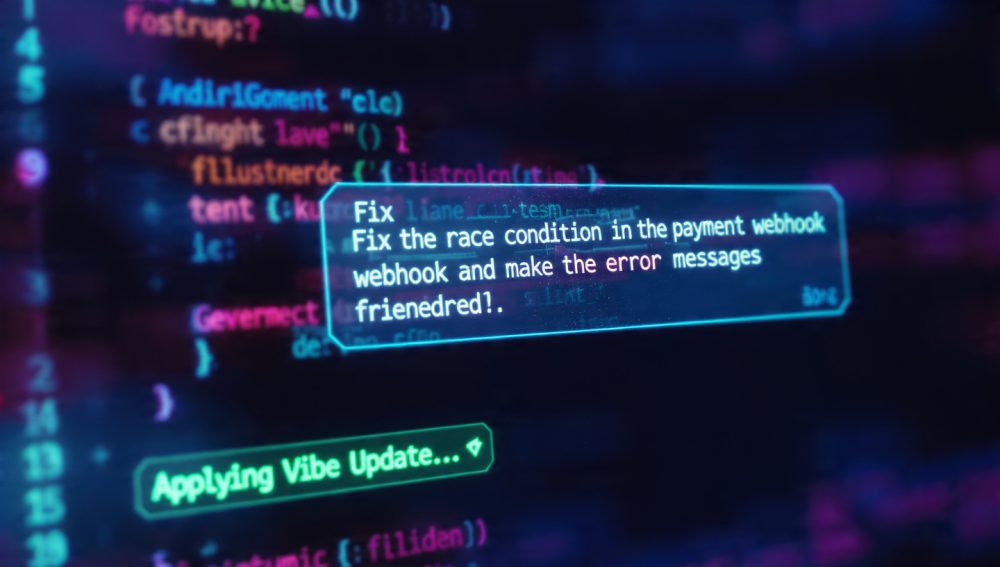
We have moved beyond simple “prompt engineering.” In 2026, we engage in prompt engineering 2026, which is really about designing agentic workflows. A single prompt is no longer enough. Instead, Vibe Coders architect systems of agents:
- ** The Architect Agent**: Breaks down the “vibe” into technical specs.
- The Coder Agent: Writes the actual syntax.
- The Critic Agent: Reviews the code for security and efficiency.
- The QA Agent: Writes and runs test suites.
This loop happens autonomously. The human role is to monitor the “Vibe Check”—ensuring the output aligns with the original vision. If the agents hallucinate, you don’t rewrite the code; you adjust the constraints and the context.
The Democratization Paradox: Can Everyone Really Code Now?
With natural language programming, the answer is technically “yes,” but professionally “it’s complicated.” While anyone can generate a functional website today, building scalable, maintainable, and secure enterprise software requires a deep understanding of system design.
Timedropper a JQuery Time PluginThe paradox is that while the floor for entry has dropped, the ceiling for complexity has skyrocketed. A novice can build a messy, unscalable app in minutes. A master Vibe Coder uses the same tools to build a robust global platform in hours. The differentiator is no longer syntax knowledge; it is domain expertise and systems thinking.
Risks and Realities: Security, Hallucinations, and Technical Debt
It’s not all smooth sailing. The reliance on automated code generation has introduced “AI Sprawl”—bloated codebases that work but are impossible to read.
- Security: AI agents often prioritize functionality over security, occasionally hardcoding credentials or using vulnerable libraries if not explicitly checked.
- Hallucinations: The “Vibe” can sometimes be misinterpreted. A request for “modern UI” might result in a broken, experimental layout if the model’s training data was skewed.
- Technical Debt: When no human writes the code, who maintains it? We are seeing the rise of “Forensic Code Auditing,” where experts are hired to reverse-engineer AI-generated spaghetti code.
Career Evolution: Moving from Programmer to Vibe Architect
If you are a developer in 2026, your title is likely changing. The “Programmer” is becoming the “Vibe Architect” or “AI Systems Orchestrator.”
Animated Donut Chart using JQuery and Snap.svg- Old Skill: Memorizing React Hooks.
- New Skill: Managing Context Windows and Agent Handoffs.
- Old Skill: Debugging Syntax Errors.
- New Skill: Debugging Intent and Logic Flows.
The most valuable employees today are those who have high “taste”—an intuitive understanding of good product design and software architecture—and can communicate that effectively to an LLM.
Getting Started: Your First 24 Hours of Vibe Coding
Ready to stop typing and start vibing? Here is your roadmap for January 17, 2026:
- Download Cursor or Replit Mobile: Stop using text editors that don’t think for you.
- Learn Context Architecture: Don’t just ask for code. specific the persona, the constraints, and the tech stack in your preamble.
- Build a “Vibe” Project: Take a crazy idea (e.g., “A social network for house plants”) and try to build the MVP in under an hour using only natural language prompts.
- Trust the Vibe: Let go of the need to control every line. Review the outcome, not just the output.
The evolution of software is here. It’s messy, it’s fast, and it’s undeniably viral. The question is: do you have the vibe?