
If 2024 was the year of the Copilot, 2026 is undoubtedly the era of the Autonomous Agent. We have moved beyond “human-in-the-loop” assistance to “human-on-the-loop” supervision.
In the current landscape, the question is no longer “Which LLM is best?”—that is a commodity conversation. The strategic differentiator for scaling enterprises is Orchestration. How do you coordinate a swarm of specialized AI workers to plan, reason, critique, and execute complex workflows without constant hand-holding?
As an Industry Visionary looking at the data from late 2025, we see a massive consolidation in the framework market. The “toy” projects have faded; what remains are robust, production-grade ecosystems designed for reliability, observability, and scale.
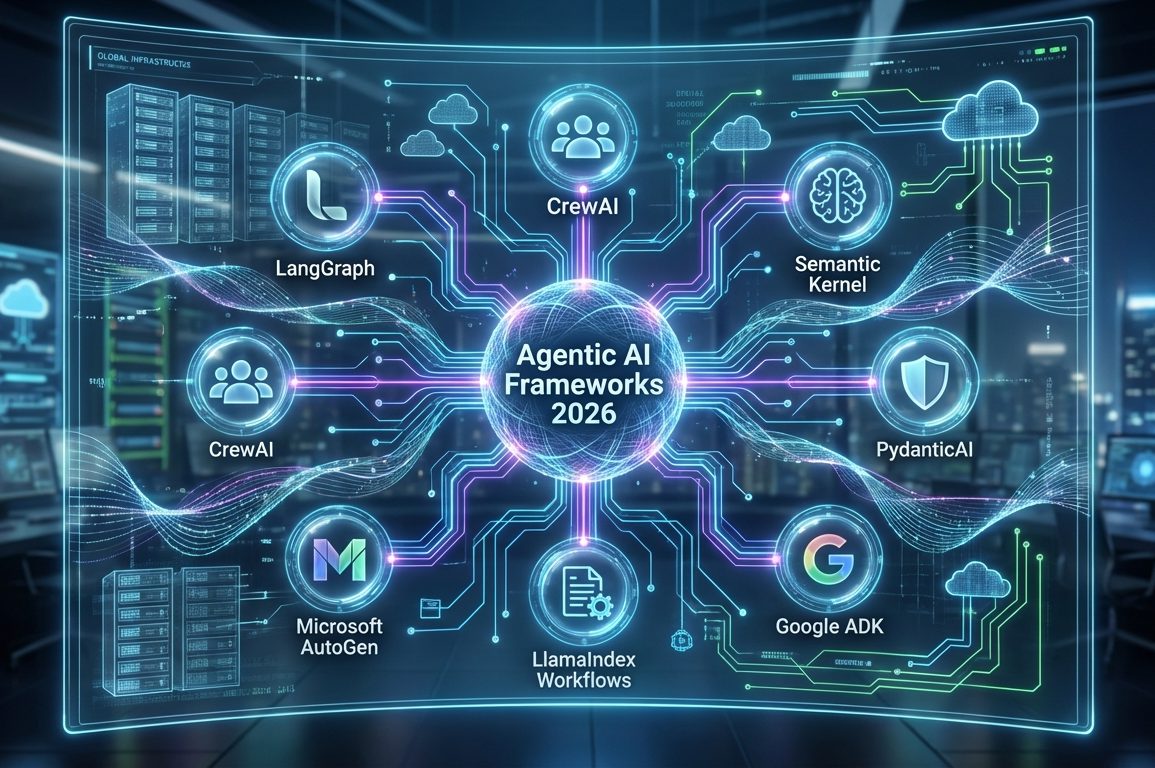
Below is the definitive strategic analysis of the Top 7 Agentic AI Frameworks you must evaluate to build the autonomous enterprise of 2026.
The Top 7 Agentic AI Frameworks (2026 Edition)
1. LangGraph (by LangChain)
The Enterprise Standard for Stateful Orchestration
Songtell: Unlocking the Hidden Depths of Your Favorite SongsWhile LangChain started the revolution, LangGraph has become the operating system for serious agentic applications. Unlike linear chains, LangGraph models agents as nodes in a graph, allowing for cycles, loops, and complex conditional logic—essential for agents that need to “think,” retry, and correct themselves.
- Core Philosophy: Agents are state machines. Control flow should be explicit and graph-based.
- Best For: Complex, multi-step workflows requiring “human-in-the-loop” approval steps, cyclical reasoning (e.g., “Plan -> Execute -> Critique -> Refine”), and granular state persistence.
- 2026 Strategic Advantage: Its seamless integration with LangSmith provides the best-in-class observability, which is the #1 requirement for taking agents from prototype to production.
2. CrewAI
The “Team-First” Collaboration Engine
CrewAI exploded in popularity by abstracting the complexity of multi-agent systems into a relatable metaphor: a Crew. You define a “Manager,” a “Researcher,” and a “Writer,” assign them distinct goals, and let them collaborate. In 2026, it has matured from a high-level wrapper into a robust framework with production features.
Translatio.AI- Core Philosophy: Role-Playing is the key to better agent performance. Specialists beat generalists.
- Best For: Process-driven teams where tasks can be clearly delegated (e.g., Marketing Content Pipelines, Market Research, Automated Reporting).
- 2026 Strategic Advantage: Its intuitive syntax allows non-senior engineers to ship multi-agent systems quickly. The new “Enterprise Hub” features offer better secret management and deployment scaling.
3. Microsoft AutoGen
The Conversation-Driven Enterprise Powerhouse
Backed by Microsoft Research, AutoGen pioneered the concept of “Conversable Agents.” In this framework, workflow is conversation. Agents (which can be LLMs, humans, or tools) solve tasks by chatting with each other. It remains the heavy hitter for complex code generation and execution tasks.
- Core Philosophy: Multi-agent conversation is the universal interface for problem-solving.
- Best For: Code-heavy tasks, complex debugging, and scenarios where you need a “User Proxy” agent to safely execute code locally or in docker containers.
- 2026 Strategic Advantage: AutoGen Studio has evolved into a full no-code/low-code interface, bridging the gap between developers and business analysts who want to design agent workflows visually.
4. LlamaIndex Workflows
The Data-Centric Agent Framework
IngestAILlamaIndex started as a data ingestion tool (RAG) but transformed into a premier agentic framework with the release of Workflows. Unlike the chat-centric models, this is event-driven. It excels where the agent’s primary “brain” is your proprietary data.
- Core Philosophy: Event-driven architecture. Agents should react to data changes and events, not just chat messages.
- Best For: RAG-heavy agents (e.g., Legal Analysts, Financial Auditors) that need to sift through massive datasets and trigger actions based on specific data findings.
- 2026 Strategic Advantage: Its “Context-Augmented” agent capabilities are unmatched. If your agent fails because it couldn’t find the right document, this is the framework to fix it.
5. Microsoft Semantic Kernel
The “Bridge” for Traditional Software Engineers
Semantic Kernel (SK) is often misunderstood as just an SDK, but in 2026, it is the stealth winner for enterprise integration. It doesn’t force you to rewrite your entire app in Python; it brings agentic capabilities (Planners, Plugins, Personas) into your existing C#, Python, or Java codebases.
Gencraft- Core Philosophy: AI should be an orchestration layer injected into native code, not a separate black box.
- Best For: Large enterprises (.NET shops) extending legacy applications with agentic features.
- 2026 Strategic Advantage: Deep integration with the Azure AI ecosystem and “Copilot” stack. If you are building internal tools for a Fortune 500 company, SK is likely your safest, most compliant bet.
6. PydanticAI
The Production-Grade, Type-Safe Challenger
Emerging rapidly in late 2025, PydanticAI (from the creators of the pervasive Pydantic validation library) addresses the biggest pain point of GenAI: Structured Reliability. It rejects the “string-in, string-out” mess of early LLM apps in favor of strict type validation and schema enforcement.
- Core Philosophy: Code-first, type-safe, and production-ready. No “magic” prompts hidden inside the library.
- Best For: Mission-critical workflows where an agent must return a valid JSON object or a specific data structure (e.g., Insurance Claims Processing, Medical Data Extraction).
- 2026 Strategic Advantage: By leveraging the familiar Pydantic ecosystem, it offers the lowest friction for Python developers who care about code quality and testing.
7. Google Agent Development Kit (ADK)
The Scalable, Gemini-Native Ecosystem
While often quieter in the open-source buzz, Google’s ADK has become a powerhouse for those leveraging the massive context windows of Gemini models. It provides a highly opinionated, scalable way to build agents that can “remember” millions of tokens of context.
- Core Philosophy: Agents are defined by their tools and their ability to handle massive context.
- Best For: Applications requiring deep multi-modal understanding (video + text agents) and huge context retention.
- 2026 Strategic Advantage: Its “Agent Engine” runtime allows for seamless deployment to Google Cloud, solving the “it works on my laptop” problem instantly.
Strategic Comparison: Choosing Your Stack
To make an informed architectural decision, compare these frameworks against your primary constraints: Control, Ease of Use, and Reliability.
| Framework | Orchestration Style | Best For… | Learning Curve | Enterprise Readiness |
|---|---|---|---|---|
| LangGraph | Graph / State Machine | Complex, looping logic & granular control | High | ⭐⭐⭐⭐⭐ |
| CrewAI | Role-Based / Hierarchical | Team-based tasks & creative delegation | Low | ⭐⭐⭐⭐ |
| AutoGen | Conversational | Code execution & autonomous solving | Medium | ⭐⭐⭐⭐ |
| LlamaIndex | Event-Driven | RAG & Data-heavy workflows | Medium | ⭐⭐⭐⭐ |
| Semantic Kernel | Native Code Integration | .NET/Enterprise legacy integration | Medium | ⭐⭐⭐⭐⭐ |
| PydanticAI | Code-First / Type-Safe | Strict data extraction & reliability | Low | ⭐⭐⭐ |
| Google ADK | Tool-Centric | High-context & Multimodal apps | Medium | ⭐⭐⭐⭐ |
Futuristic Predictions: The “Agentic” Landscape of Late 2026
As an Industry Visionary, I see three critical shifts occurring in the next 12 months that will define the winners and losers in this space:
- The Rise of “FinOps for Agents”: We are moving past “token counting.” In late 2026, frameworks will natively include “Cost-per-Outcome” metrics. You won’t ask how much the model costs; you’ll ask how much the Agent spent to close that ticket. Frameworks like LangGraph are already building hooks for this economic modeling.
- Protocol Standardization (MCP): The Model Context Protocol (MCP) is becoming the “USB-C” of AI tools. We predict that by the end of 2026, frameworks that do not natively support MCP for tool connectivity will be obsolete. Expect seamless interoperability where a “CrewAI” agent can borrow a tool built for a “Semantic Kernel” agent.
- Self-Correcting “Immune Systems”: The next frontier is not just planning but healing. We expect the top frameworks to introduce “Guardian Agents”—background processes that monitor the primary agents for hallucinations or loops and autonomously patch the prompt or reset the state without human intervention.
FAQ: Navigating the Agentic Era
If you are prototyping for a demo, use a Builder. If you are building intellectual property (IP) for your company that needs to scale, you must use a Framework (code). Builders are brittle; Frameworks are version-controlled assets.
Yes. A common pattern in 2026 is to use LangGraph for the high-level orchestration (the “State Machine”) and CrewAI or PydanticAI to build the individual leaf nodes (the specialized workers).
AutoGPT was the pioneer (the “Netscape Navigator” of agents), but for enterprise scaling in 2026, frameworks like AutoGen and CrewAI have surpassed it in terms of reliability, developer experience, and control.
CrewAI is the most accessible. Its Python syntax reads almost like English, making it easier to understand the logic without deep computer science knowledge.
Final Thought: The “Agentic AI” revolution is an architectural shift, not just a model upgrade. Choosing the right framework today is akin to choosing between React and Angular in 2015—it will dictate your velocity for the next decade. Choose wisely.