

What is Rust-based HFT API Design? Rust-based High-Frequency Trading (HFT) API design is the architectural practice of utilizing the Rust programming language to build financial trading systems that achieve sub-microsecond tick-to-trade latency. Unlike traditional languages, Rust provides memory safety without a Garbage Collector (GC), ensuring deterministic latency—the holy grail of HFT. By leveraging zero-cost abstractions, ownership semantics, and modern compiler optimizations (LLVM), Rust allows developers to write code that rivals C++ in speed while eliminating memory-related crashes and unpredictable jitter.
In the world of algorithmic trading, milliseconds are for amateurs. We are now operating in the realm of nanoseconds. If your API suffers from a 10-millisecond GC pause during a market crash, you don’t just lose a trade; you might lose the firm. This guide is your blueprint for abandoning legacy debt and building the next generation of financial infrastructure.
Deep Dive: Why Rust is the New King of HFT
The Historical Context: The C++ Monopoly
For three decades, C++ has held a monopoly on HFT. It offered raw access to hardware, manual memory management, and templates for code generation. However, this power came with a heavy price: Undefined Behavior (UB). Buffer overflows, use-after-free errors, and data races are notoriously difficult to debug in concurrent C++ systems. In HFT, a pointer error can result in sending erroneous orders to an exchange, triggering massive financial liability.
The Rust Revolution: Safety Without Sacrifice
Rust has emerged not just as an alternative, but as a superior successor. It solves the “Trilemma” of HFT:
- Safety: Compile-time guarantees against data races.
- Speed: No runtime overhead; performance parity with C++.
- Concurrency: Fearless parallelism.
The crucial differentiator is the lack of a Garbage Collector. Java and Go, while popular for general fintech, are non-starters for core HFT engines because they pause execution to clean up memory. Rust’s ownership model handles memory at compile time. This ensures that the 99th percentile latency (tail latency) remains flat and predictable.
Artificial Intelligence Creating a Website by Looking at the Whiteboard Wireframe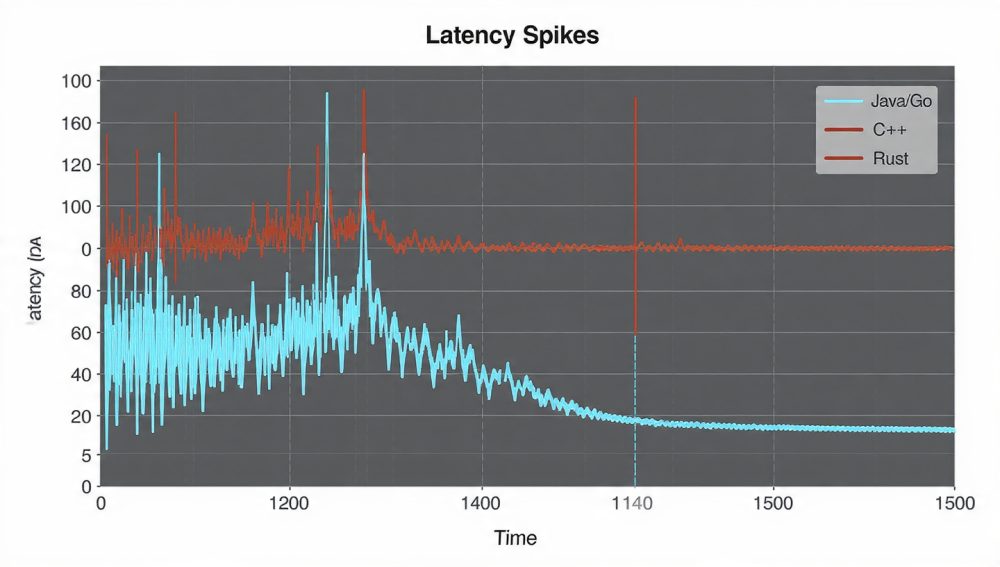
Future Predictions (2026 and Beyond)
As exchanges move toward 100GbE (Gigabit Ethernet) handoffs and FPGA integration becomes standard, software APIs must act as thin orchestration layers for hardware. Rust’s ability to interface seamlessly with C and compile to WASM (for web-based dashboards) while handling raw memory manipulation makes it the only viable contender to displace C++ in the next five years.
Core Architecture: Designing for Nanoseconds
Building a Rust HFT API requires a fundamental shift in how you view system resources. You are not building a web server; you are building a data pipeline that fights the laws of physics.
A. The Thread-Per-Core Model
In standard web APIs, you might use an async runtime like tokio with a work-stealing scheduler. In HFT, context switching is the enemy.
The Strategy: Use a Thread-per-Core architecture (pinning threads to CPU cores).
- Core 0: Network I/O (Kernel Bypass/DPDK).
- Core 1: Deserialization & Normalization.
- Core 2: Strategy Engine (The Brain).
- Core 3: Order Management & Risk Checks.
By isolating these tasks and pinning them, you prevent the OS scheduler from moving your process to a cold cache, ensuring L1/L2 cache locality.
B. Memory Management: The Hot Path
The “Hot Path” is the code execution path taken when a market tick arrives and an order is sent. Allocations on the hot path are forbidden.
Content Filter with CSS and jQuery- Pre-allocation: Use Object Pools or Arenas (
bumpalocrate) to pre-allocate memory at startup. - Stack vs. Heap: Prefer stack allocation (
array,smallvec) over heap allocation (Vec,Box) whenever the size is known. - Zero-Copy: Do not copy data from the network buffer to your struct. Use references and lifetimes to read data directly from the raw bytes.
C. Networking: Escaping the Kernel
Standard TCP/IP stacks provided by the OS are too slow. They involve context switches from User Space to Kernel Space.
- Kernel Bypass: Utilize technologies like DPDK (Data Plane Development Kit) or Solarflare’s OpenOnload. Rust bindings for these (like
dpdk-rs) allow your application to poll the Network Interface Card (NIC) directly.
Actionable Value: Step-by-Step API Implementation
Here is how to structure a lock-free, zero-copy HFT loop in Rust.
Step 1: Define the Data Structure (Zero-Copy)
We use the rkyv crate or raw pointer casting for zero-copy deserialization. Standard serde with JSON is too slow.
#[repr(C, packed)]
#[derive(Debug, Copy, Clone)]
pub struct MarketTick {
    pub timestamp: u64,
    pub symbol_id: u32,
    pub bid_price: u64, // Fixed-point arithmetic (avoid floats)
    pub ask_price: u64,
    pub bid_qty: u32,
    pub ask_qty: u32,
}
// Note: #[repr(C, packed)] ensures memory layout matches the wire format exactly.
Step 2: The Ring Buffer (Disruptor Pattern)
Use a Single-Producer Multi-Consumer (SPMC) ring buffer to pass ticks from the Network thread to the Strategy thread without locks (Mutex is forbidden). The crossbeam crate or a custom bounded channel is standard here.
use crossbeam::queue::ArrayQueue;
use std::sync::Arc;

// Pre-allocate a queue of 1 million ticks
let queue: Arc<ArrayQueue<MarketTick>> = Arc::new(ArrayQueue::new(1_000_000));
Step 3: The Hot Loop (SIMD Optimized)
The strategy engine processes the queue. We use aggressive inlining and target specific CPU features (AVX2/AVX-512).
#[inline(always)]
fn process_tick(tick: &MarketTick) -> Option<Order> {
    // Simple arbitrage logic
    if tick.ask_price < TARGET_PRICE {
        return Some(Order::new(Buy, tick.symbol_id, tick.ask_price));
    }
    None
}

fn strategy_thread(queue: Arc<ArrayQueue<MarketTick>>) {
    // Pin this thread to Core 2
    core_affinity::set_for_current(core_affinity::CoreId { id: 2 });

    loop {
        if let Some(tick) = queue.pop() {
            if let Some(order) = process_tick(&tick) {
                send_order_fast(order);
            }
        } else {
            // Busy spin - DO NOT SLEEP
            std::hint::spin_loop();
        }
    }
}
Step 4: Fixed-Point Arithmetic
Never use f64 for money. Floating point math is non-associative and slower. Use integer math representing the price in nanos (e.g., $100.50 -> 10050000000).
Comparative Data: Rust vs. The World
The following table compares Rust against major competitors in the HFT space.
| Feature | Rust | C++ (Modern) | Java | Go |
|---|---|---|---|---|
| Memory Safety | Compile-time (Ownership) | Manual (RAII/Smart Ptrs) | GC Managed | GC Managed |
| Latency Jitter | Near Zero | Low (risk of fragmentation) | High (GC Pauses) | Moderate (GC Pauses) |
| Development Speed | Medium (Steep curve) | Slow (Legacy debt) | Fast | Fast |
| Concurrency | “Fearless” (Race-free) | Complex (Undefined Behavior) | Easy (Threads) | Easy (Goroutines) |
| Package Management | Cargo (Excellent) | CMake/Conan (Painful) | Maven/Gradle | Go Modules |
| Best Use Case | Greenfield HFT Core | Legacy Maintenance | OMS / Middle Office | Crypto Connectors |
Expert Insights: The “Unsafe” Reality
PRO TIP: Embrace unsafe, but contain it.
To achieve true C++ parity, you will eventually need Rust’s unsafe keyword. You might need to cast a raw byte buffer from a UDP packet directly into a struct to save the cost of validation.
The Golden Rule: Wrap unsafe blocks in safe, thoroughly tested abstractions.
- Bad: Scattering raw pointer dereferences throughout your strategy logic.
- Good: Writing a
PacketParsermodule that usesunsafeinternally for speed but exposes a safe API to the rest of the system.
Regulatory Compliance & Auditability
HFT isn’t just about code; it’s about law. A key advantage of Rust is immutability by default. This makes building an audit trail (a requirement for MiFID II and SEC Rule 613) significantly more reliable. You can mathematically prove that certain threads could not have altered the state of an order after it was generated.
Comprehensive FAQ
Is Rust faster than C++ for High-Frequency Trading?
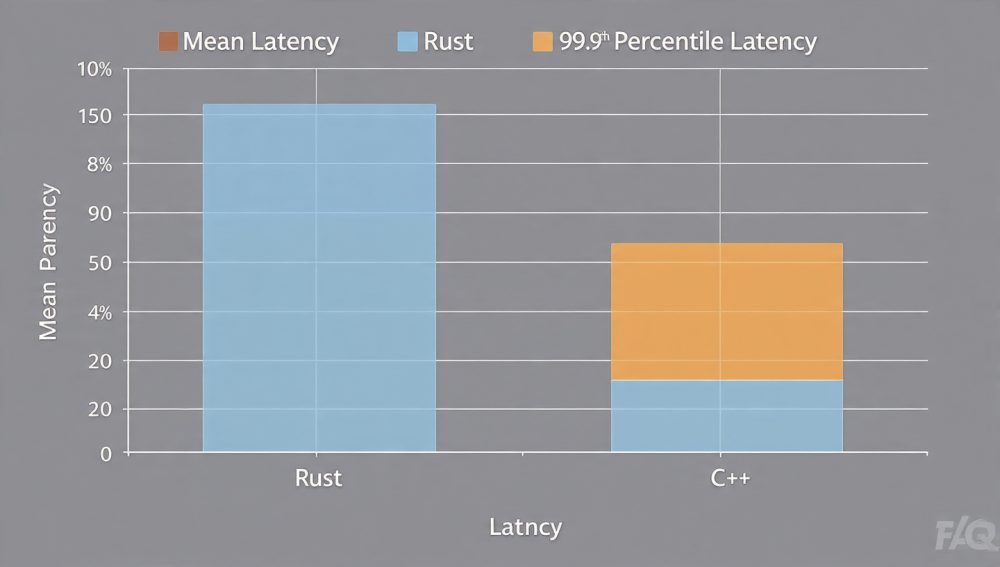
Rust is generally on par with C++ regarding raw throughput and mean latency. However, Rust often outperforms C++ in tail latency (consistency) because its strict memory management prevents heap fragmentation and memory leaks over long trading sessions.
What is the “Hot Path” in HFT API Design?
The Hot Path is the critical code execution sequence that occurs between receiving market data and sending an order. In Rust HFT design, this path must be allocation-free, lock-free, and panic-free to ensure minimal latency.
Which Rust crates are essential for HFT?
Essential crates include Crossbeam (lock-free data structures), Tokio (for non-critical async IO), Rkyv or Bincode (zero-copy serialization), Mmap (memory mapping), and Core_affinity (CPU pinning).
Why should I avoid `Arc>` in HFT?
Mutexes involve operating system syscalls to put threads to sleep when contention occurs. This context switch costs microseconds—an eternity in HFT. Instead, use atomics, spinlocks, or single-threaded ownership models with message passing.
Advanced Optimization Techniques (The Secret Sauce)
To truly secure the “Zero Position,” we must go beyond the basics.
Cache Line Padding
Modern CPUs fetch memory in 64-byte chunks called cache lines. If two threads modify different variables that sit on the same cache line, you get “False Sharing,” causing the CPU cores to fight for ownership of that cache line.
Solution: Pad your structs in Rust.
#[repr(align(64))]
struct AlignedCounter(AtomicUsize);
This ensures your counters sit on their own cache lines, drastically improving concurrent write performance.
SIMD (Single Instruction, Multiple Data)
Rust allows you to use intrinsics (via the std::arch module) or crates like simd-json. If you are calculating the moving average of 8 different stocks, SIMD allows you to perform the math for all 8 in a single CPU cycle.
Warm-up Phases
JIT-compiled languages need warm-up, but even compiled languages like Rust benefit from it. Before the market opens, run your strategy loop 100,000 times with dummy data. This ensures:
- The OS has paged all your binary code into physical RAM (avoiding page faults).
- The CPU branch predictor has “learned” the likely paths of your code.
- Your memory arenas are fully allocated.
Conclusion: The Rust Advantage
Designing a Real-time HFT API in Rust is an exercise in discipline. It requires unlearning the comforts of high-level web development and embracing the hardware reality.
The benefits, however, are undeniable. By adopting Rust, you gain the raw performance of C++ with the safety guarantees of a modern language. You eliminate the entire class of memory-bug-related crashes. You gain a package manager (Cargo) that actually works. Most importantly, you gain confidence.
In a market where algorithms fight for position in the queue, confidence in your system’s stability and speed is the ultimate edge. The era of C++ hegemony is ending. The future of HFT is oxidized.
Ready to build? Start by profiling your current bottlenecks and rewriting your serialization layer in Rust. The nanoseconds are waiting.