

Real estate tokenization is not the “Wild West”—it is highly regulated finance.
The promise of liquidity and fractional ownership has ignited a $16 trillion revolution, but for issuers and platforms, the barrier to entry is not technology; it is the law. Misunderstanding the legal framework doesn’t just mean a failed project; it can mean federal indictments, frozen assets, and massive SEC fines.
This is the ultimate guide to navigating the complex legal labyrinth of tokenized real estate crowdfunding. Whether you are structuring a deal in New York, launching a platform in Dubai, or ensuring compliance in the EU, this guide covers the critical regulations, technical standards, and strategic nuances you need to rank #1 in trust and compliance.
The Global Regulatory Landscape: A Patchwork of Laws
The first rule of tokenization: Tokens representing real estate are almost always securities.
Unlike utility tokens or cryptocurrencies (like Bitcoin), a real estate token represents an investment contract—an expectation of profit from the efforts of others (the Howey Test). This classification triggers a cascade of securities laws designed to protect investors.The Angry Man Illusion Will Blow Your Mind!
United States: The SEC Framework
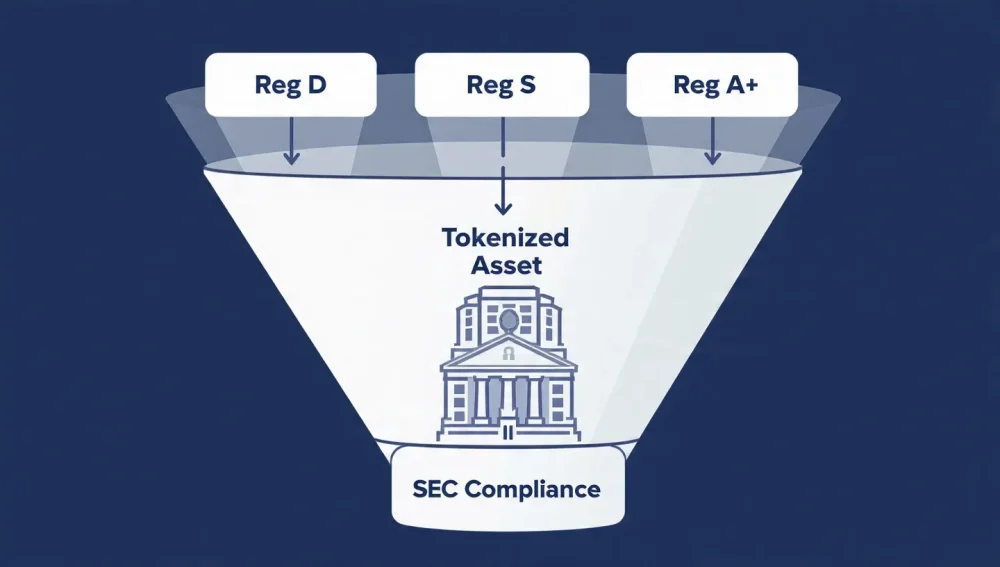
In the US, the Securities and Exchange Commission (SEC) is the primary watchdog. There is no “crypto exemption” for real estate. You generally have two paths: register a public offering (IPO)—which is prohibitively expensive—or use an exemption.
| Regulation | Max Raise | Investor Type | Solicitation | Best For |
|---|---|---|---|---|
| Reg D (506c) | Unlimited | Accredited Only | General Solicitation Allowed | Large commercial deals, institutional focus. |
| Reg D (506b) | Unlimited | Accredited + 35 Sophisticated | No General Solicitation | Private deals with existing networks. |
| Reg S | Unlimited | Non-US Persons Only | Offshore Solicitation | Raising capital from international investors. |
| Reg A+ (Tier 2) | $75M / 12 mos | Anyone (Retail & Accredited) | General Solicitation Allowed | “Mini-IPO” for platforms wanting retail scale. |
| Reg CF | $5M / 12 mos | Anyone | Online Portals Only | Early-stage projects or single-family homes. |
Strategist’s Note: Most successful platforms (like RealT or HoneyBricks) utilize a “stack” approach. They might combine Reg D (506c) for US accredited investors with Reg S for international investors to maximize their capital pool while remaining compliant.
European Union: MiCA and The Prospectus Regulation
Europe has taken a massive leap forward with MiCA (Markets in Crypto-Assets), but here is the trap: MiCA explicitly excludes security tokens.
If your token represents a share in a property or SPV (Special Purpose Vehicle), it falls under MiFID II and the Prospectus Regulation.Proof of Human: The 2026 Guide to Uncopyable Post-Latent Logo Design
- The Prospectus Rule: Generally, offering securities to the public requires a costly prospectus approved by a national regulator (like BaFin in Germany or AMF in France).
- Passporting: Once approved in one EU country, you can “passport” that prospectus to offer tokens across the entire EU.
- The Exemption: Many issuers keep the offer under €8 million (varies by country) or limit it to 150 investors per country to avoid the full prospectus requirement.
Emerging Hubs: Dubai and Singapore
- Dubai (VARA): The Virtual Assets Regulatory Authority (VARA) has created specific rulebooks for Real World Assets (RWAs). They require a partnership with a licensed tokenization platform and strict adherence to the Dubai Land Department’s title deed digitization initiatives.
- Singapore (MAS): The Monetary Authority of Singapore treats these as “Capital Markets Products.” They have a sandbox approach (Project Guardian) that is very friendly to institutional innovation but strict on retail protection.
Structuring the Deal: The Legal Wrapper
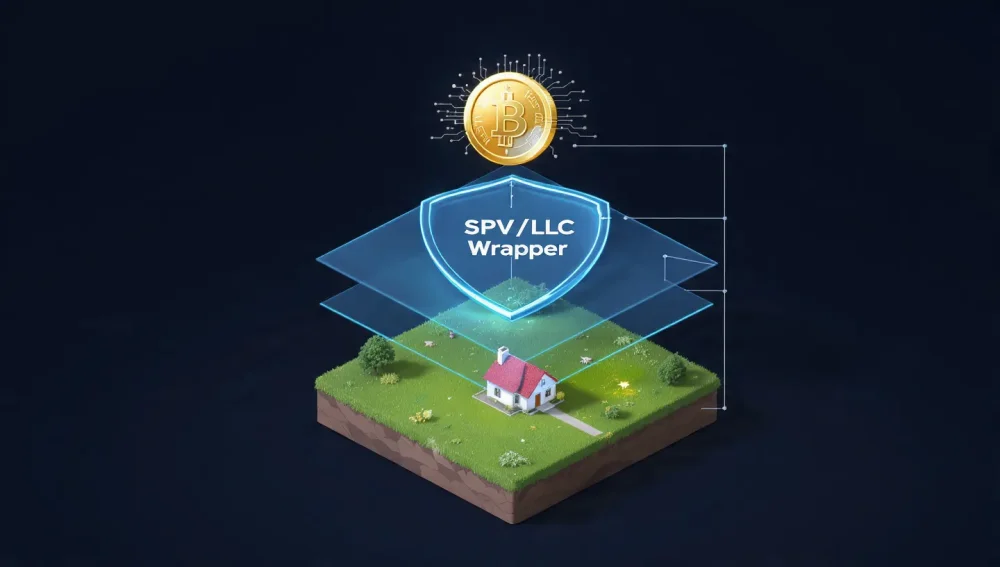
You cannot just “tokenize a house.” You tokenize the entity that owns the house. This is known as the SPV (Special Purpose Vehicle) Structure.
- The Asset: The physical property (e.g., an apartment complex).
- The SPV: A legal entity (LLC, LTD, or Series LLC) is created solely to hold the property deed.
- The Token: The token represents a share or membership interest in that SPV.
The “Oracle Problem” in Law: How do you ensure the token is the legal ownership?
- Hard Link: The SPV’s Operating Agreement must explicitly state that the only valid record of ownership is the blockchain ledger (specifically the smart contract address).
- Series LLCs: Platforms like RealT use Delaware Series LLCs. This allows one master LLC to spawn infinite “child” Series, each owning one property. This segregates liability—if one house burns down, the assets of the other Series are safe.
Technical Compliance: Code is Law (But Law Rules Code)
Compliance must be baked into the smart contract. You cannot rely on a “gentleman’s agreement” that investors won’t sell to terrorists.
The Battle of Standards: ERC-3643 vs. ERC-1400
Standard ERC-20 tokens are insufficient for securities because they are too free. If a drug lord buys your token on Uniswap, you are liable.35+ Secret Midjourney V6 Prompts for Professional Logo Design in 2026
- ERC-1400 (The Partitioned Token): An early attempt at security tokens. It allows for “partitions” (tranches) of tokens and has some compliance features. However, it is complex and often incompatible with standard DeFi wallets.
- ERC-3643 (The Permissioned Token): The new industry gold standard (formerly T-REX). It uses an ONCHAINID system.
- How it works: The token contract checks a central “Identity Registry” before every single transfer.
- The Check: “Is the receiver’s wallet address on the whitelist?”
- Yes: Transfer executes.
- No: Transaction reverts (fails).
- Why it wins: It creates a “walled garden” on a public blockchain. You get the security of Ethereum with the compliance of a private stock exchange.
Automated Compliance Features
Your smart contracts must automatically enforce:
- Lock-up Periods: Preventing Reg D investors from selling for 12 months.
- Investor Limits: Ensuring you don’t cross the 2,000 investor threshold (in the US) which triggers public reporting.
- Country Bans: Automatically blocking wallets associated with sanctioned countries (OFAC lists).
KYC/AML: The Non-Negotiable Pillar
Know Your Customer (KYC) and Anti-Money Laundering (AML) are not one-time events; they are lifecycle requirements.
The Onboarding Flow
- Liveness Check: User uploads a selfie and passport. AI verifies they match and are a real person.
- Database Screening: User is checked against Interpol, FBI, and sanctions lists.
- Accreditation Verification: For Reg D (506c), users must upload bank statements or tax returns to prove net worth/income.
- Wallet Whitelisting: Once approved, the user’s specific wallet address is added to the smart contract’s whitelist.
Critical Risk: Secondary Markets. If User A sells to User B on a secondary market, User B MUST have already undergone KYC. The smart contract (ERC-3643) prevents the transfer otherwise. This eliminates the risk of peer-to-peer compliance breaches.
Case Study: Navigating the Legal Maze
The “Tiny-Home” Success: OWR Invest (Portugal)
While US giants focus on commercial towers, OWR Invest in Portugal took a niche approach: Eco-friendly tiny homes.10 Best Agentic AI Workflow Automation Tools for 2026
- The Challenge: Portuguese law doesn’t have a “tiny home” category, and securities laws are strict.
- The Solution: They used a profit-sharing agreement model rather than direct title tokenization initially, navigating local zoning laws by keeping structures mobile.
- The Compliance: They utilized a strict KYC process for EU investors, complying with GDPR for data privacy, ensuring that their “community” of investors were legally recognized as lenders/partners in the project rather than just crypto-holders.
The Institutional Giant: St. Regis Aspen (USA)
- The Deal: $18 million raised via Security Token Offering (STO).
- The Reg: Reg D (506c).
- The Lesson: They marketed exclusively to accredited investors. The tokens represent indirect ownership in the resort. This proved that high-value assets could be tokenized if the “velvet rope” of accreditation was strictly enforced.
Secondary Trading: The Liquidity Holy Grail
The dream is to trade real estate like stocks. The reality is strict regulation.
ATS (Alternative Trading Systems)
In the US, you cannot trade security tokens on Coinbase or Binance. You must use an SEC-registered ATS (like tZERO or INX).
- Legal Status: These are broker-dealers authorized to match buy/sell orders for securities.
- Integration: The ATS connects to your whitelist. When a trade happens, the ATS updates the cap table and the blockchain records simultaneously.
The DEX Dilemma
Can you trade on Uniswap? No. Standard DEXs (Decentralized Exchanges) are permissionless. They don’t check KYC.
- The Future: Permissioned DEXs. These are liquidity pools where only whitelisted wallets can interact. If you aren’t KYC’d, the “Swap” button simply doesn’t work.
Tax Compliance: The Hidden Trap
Legal compliance isn’t just about SEC fines; it’s about the IRS.Generative Engine Optimization (GEO): The Complete Blueprint for Winning Answer Ownership in the Age of AI
- Pass-Through Taxation: Most SPVs are LLCs, meaning they are pass-through entities. The SPV pays no tax; the token holder does.
- K-1 Forms: In the US, every token holder needs a Schedule K-1 form at the end of the year.
- The Nightmare: Imagine issuing 5,000 K-1s for a $50 investment.
- The Fix: Some platforms use a “Blocker Corporation” (C-Corp) structure. The Corp pays the tax, and investors get dividends (Form 1099), which is much simpler, though it introduces double taxation.
- Withholding: For international investors (Reg S), the platform must withhold ~30% of rental income for US taxes (FDAP income) unless a tax treaty exists.

FAQ: Tokenized Real Estate Legal Compliance
ERC-20 is a free-for-all token standard. ERC-3643 is a “permissioned” standard designed for securities. ERC-3643 checks an on-chain identity registry before allowing any transfer, ensuring that only KYC-verified investors can hold or trade the token.
MiCA largely exempts security tokens, meaning they fall under existing securities laws (MiFID II). However, MiCA does regulate the “CASPs” (Crypto-Asset Service Providers) that might custody or trade these tokens, ensuring higher standards for the platforms themselves.
It refers to the disconnect between the digital token and the physical deed. If the deed is at the county clerk’s office, but the token is on the blockchain, how do they stay in sync? The legal workaround is an SPV where the Operating Agreement legally binds the entity’s ownership to the blockchain record.
No. OpenSea is for NFTs (collectibles/art). Real estate tokens are securities. Trading them on an unregulated marketplace would be a violation of federal securities laws. They must be traded on an ATS or a compliant peer-to-peer venue.
Absolutely. Do not attempt this with “template” documents. You need a securities lawyer to draft the Private Placement Memorandum (PPM), Operating Agreement, and Subscription Agreement to ensure they align with your smart contract logic.
No. Unlike Bitcoin, security tokens are “permissioned.” The issuer (the real estate company) has the legal authority and technical ability to “burn” your lost tokens and “mint” new ones to a new wallet. Your ownership is recorded in the company’s legal books, not just the blockchain.
No. Under Reg D (506c), you can only sell to Accredited Investors. Under Reg A+ and Reg CF, you can sell to non-accredited (retail) investors, but there are strict limits on how much they can invest and how much you can raise.
Yes, but only if treated as a security. It must be registered with the SEC or (more commonly) structured under an exemption like Regulation D, Regulation A+, or Regulation CF.