
The energy storage revolution has arrived, and it isn’t powered by lithium alone. As we settle into 2026, sodium-ion batteries (SIBs) have graduated from experimental labs to real-world residential garages.
If you are looking to store solar energy, back up your home during blackouts, or go completely off-grid, you likely have one burning question: Is sodium-ion ready for my home?
For homeowners in colder climates or those seeking a safer, more sustainable alternative to Lithium Iron Phosphate (LiFePO4), the answer is a resounding yes. This guide will walk you through the leading brands, available models, critical technical benefits, and exactly how to integrate this new technology into your home energy system.
Why Sodium-Ion? The “Salt” Revolution Explained
Before we list the brands, it is vital to understand why the market is shifting. Sodium-ion batteries replace the scarce lithium in the cathode with abundant sodium—chemically similar to table salt.
The “Killer App”: Cold Weather Performance
The single biggest advantage of sodium-ion for home storage is its cryogenic performance.
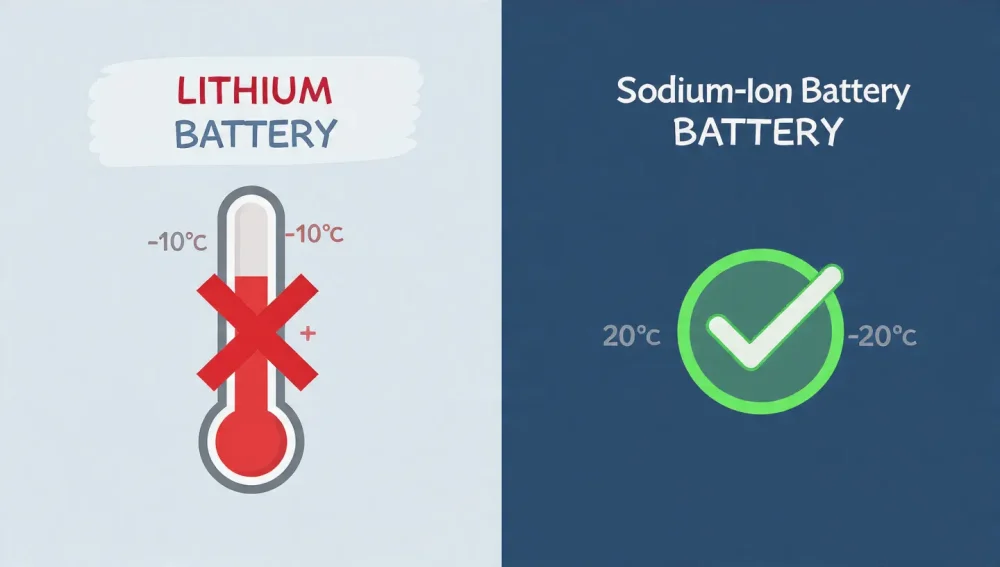
What is a Mild Disability? You May Be Surprised!- Lithium-ion (LFP): Struggles to charge below 0°C (32°F) and loses significant capacity below -10°C.
- Sodium-ion: Retains over 90% capacity at -20°C (-4°F) and can safely charge/discharge down to -40°C.
For homeowners in Canada, Northern Europe, and the Northern US, this eliminates the need for expensive battery heating pads or insulated garage enclosures.
Safety and Cost
- Safety: Sodium batteries have a lower risk of thermal runaway (fire) than traditional NMC lithium batteries and can be discharged to 0 volts for safe transport (lithium is permanently damaged if it hits 0V).
- Cost: While currently priced similarly to premium LFP units due to lower manufacturing volumes, raw material costs for sodium cells are 30-40% lower. Expect rapid price drops throughout 2026 as gigafactories from CATL and HiNa scale up.
Top Sodium-Ion Battery Brands for Home Storage (2026)
While industry giants like CATL produce the cells, only a few brands have packaged them into consumer-ready home storage systems. Here are the top players you can buy or pre-order today.
1. Biwatt Power
Best For: Whole-Home Integration
Biwatt has emerged as the market leader for dedicated residential sodium-ion systems. Their “PowerNest” series is the first widely available all-in-one solution.
- Key Product: PowerNest W1 & R3
- Capacity: The W1 is an all-in-one wall unit, while the R3 is a stackable modular system (start small, expand later).
- Specs:
- Cycle Life: 3,000+ cycles (at 80% retention).
- Round-Trip Efficiency: ~95%.
- Temperature Range: -40°C to +60°C.
- Pricing: Approx. $750 – $800 per kWh (installed).
- Verdict: The “Tesla Powerwall” of the sodium world. If you want a plug-and-play solution that looks good on your wall, this is it.
2. Bluetti
Best For: Portable Backup & Emergency Power
Known for their solar generators, Bluetti beat many competitors to the punch with the launch of the Pioneer Na in late 2025.
- Key Product: Bluetti Pioneer Na / NA300
- Capacity: 3,000Wh (expandable).
- Specs:
- Inverter: 3,000W Pure Sine Wave.
- Charging: 0-80% in 30 minutes.
- Cold Weather: Operates flawlessly at -20°C.
- Pricing: ~$2,500 for the base unit.
- Verdict: Ideal for renters, van lifers, or homeowners who need emergency backup without hardwiring a permanent system. It bridges the gap between a portable “solar generator” and a home battery.
3. CATL (Contemporary Amperex Technology Co. Limited)
Best For: The Tech Inside
You cannot buy a “CATL branded” home battery off the shelf, but you will buy batteries containing their Naxtra cells. CATL supplies the raw cells to many white-label solar integrators.
- Why it matters: If your local solar installer offers a generic “Sodium-Ion Home Battery,” ask if it uses CATL or HiNa cells. CATL cells are the gold standard for density (160Wh/kg) and reliability.
4. Regional Innovators (Europe & UK)
- Salzstrom (Austria): Offers the “R2” home storage system. They focus heavily on sustainability and European safety certifications (CE).
- Eleven Energy (UK): Provides a complete package including a 6kW hybrid inverter paired with sodium storage, specifically tuned for the UK’s damp, chilly climate.
- Freen: Specializes in 7.5 kWh floor-mounted modules compatible with wind and solar inputs.
Technical Deep Dive: Sodium-Ion vs. LiFePO4
Is sodium better than the current king of home storage, Lithium Iron Phosphate (LiFePO4)?
Autonomous Agent Orchestration (AgentOps): The 2026 Blueprint for Scalable AI| Feature | Sodium-Ion (Na-ion) | LiFePO4 (Lithium) | Winner |
|---|---|---|---|
| Energy Density | 140–170 Wh/kg | 160–180 Wh/kg | LiFePO4 (Slightly) |
| Cycle Life | 3,000 – 5,000 | 6,000 – 8,000+ | LiFePO4 |
| Cold Weather | 90% capacity at -20°C | <50% capacity at -20°C | Sodium-Ion (By far) |
| Safety | High (Can discharge to 0V) | High (Stable chemistry) | Tie |
| Cost (2026) | $120–$150 / kWh (System) | $130–$180 / kWh (System) | Sodium-Ion (Trending Lower) |
| Sustainability | Abundant materials (Salt) | Requires Lithium mining | Sodium-Ion |
The Takeaway: Choose LiFePO4 if you live in a moderate climate and want the absolute longest lifespan (20 years). Choose Sodium-Ion if you live in a cold climate (US Northeast, Canada, Northern Europe) or prioritize eco-friendliness and lower fire risk.
Installation Guide: Making It Work
Installing a sodium-ion battery is slightly different from a standard lithium installation. Here is what you need to know.
1. Inverter Compatibility is Key
Sodium-ion batteries have a much wider voltage range (typically 1.5V to 4.0V per cell) compared to lithium.
Find Out What Does Graphic Designer Do On Daily Basis?- The Problem: Older inverters might think the battery is “empty” when it still has 30% charge because the voltage has dropped below the standard lithium cutoff.
- The Solution: You need a “Sodium-Compatible” Hybrid Inverter.
- Deye: The current industry favorite. Deye hybrid inverters have wide DC input ranges and specific firmware settings for sodium batteries.
- Victron Energy: Highly configurable. Can be programmed to handle sodium voltage curves, making them excellent for DIY off-grid builds.
- Sol-Ark: Newer models (15k and up) are rolling out firmware updates to support sodium profiles.
2. Sizing Your System
Because sodium-ion batteries are slightly less energy-dense, they are physically larger than lithium batteries of the same capacity.
- Space: Ensure your garage wall or utility room has about 20% more space allocated for the battery bank compared to a Tesla Powerwall or Enphase IQ battery.
- Weight: They are also slightly heavier. Wall mounting requires hitting studs perfectly or using a reinforced backing plate.
3. The “0 Volt” Advantage
One unique installation perk is that sodium batteries can be transported at 0% state of charge (0 volts).
- Safety: There is zero risk of shock during installation hookup.
- Storage: You can leave a sodium battery unplugged in a freezing cabin for a year, and unlike lithium (which would brick itself), the sodium battery can be charged back up to 100% with no damage.
Future Outlook: What to Expect in Late 2026 and 2027
The market is moving fast. Here is what our analysts predict for the next 18 months:
- The “Under $50/kWh” Cell: Analysts like IDTechEx predict cell costs will drop below $50/kWh. This will make home storage systems significantly cheaper than grid electricity in many regions.
- Major Brand Adoption: Expect EcoFlow and Jackery to release larger whole-home sodium units (beyond the portable Pioneer Na) to compete with Biwatt.
- Vehicle-to-Home (V2H): With the launch of sodium-ion EVs (like the BYD Seagull and SOL E10X), we will see bi-directional chargers that let you use your sodium-car battery to power your house—leveraging the superior cold-weather resilience of the car itself.
FAQ: Sodium-Ion Home Batteries
1. Can I mix sodium-ion batteries with my existing lithium batteries?
No. The voltage curves and internal resistance are different. Connecting them in parallel would cause dangerous cross-currents. You can, however, use them in an AC-coupled system (where the sodium battery has its own inverter and the lithium battery has its own inverter), but they cannot share the same DC bus.
2. Are sodium-ion batteries cheaper than lithium right now?
At the cell level, yes. At the system level (what you buy), they are comparable or slightly cheaper ($700-$800/kWh installed). The massive price gap (where sodium is 30-50% cheaper) is expected to materialize fully by 2027 as production volume matches lithium.
3. Will a sodium battery work with my existing solar panels?
Yes. Solar panels don’t care what battery chemistry you use. The critical link is the inverter. As long as your hybrid inverter supports the voltage range of the sodium battery, your existing panels will work perfectly.
4. How long do sodium-ion batteries last?
Current residential models offer 3,000 to 5,000 cycles (approx. 10-15 years of daily use). While this is lower than premium LiFePO4 (which can hit 15+ years), the ability to withstand harsh temperatures often means the real-world lifespan of a sodium battery in a cold garage is actually superior to a lithium battery that degrades from cold stress.
5. Where can I buy a sodium-ion home battery?
You likely won’t find whole-home systems at Home Depot yet.
- US/Canada: Look for specialized off-grid distributors or contact Bluetti directly for their portable/home integration kits.
- Europe: Brands like Biwatt and Salzstrom have distribution networks in Germany, Austria, and the UK. Check with certified solar installers who carry Deye inverters, as they often have access to compatible sodium battery stocks.