
If you want to learn how to be a seo content writer in 2026, you must first accept that the rules have fundamentally shifted. SEO writing has changed more in the last three years than in the previous ten combined. It is no longer just about stuffing keywords into paragraphs; rather, it is about being the architect of information in an AI-first world.
This guide takes you from novice to pro, mastering the hybrid skills required to rank in 2026. Whether you are wondering is seo writing a good career in 2026 or looking to upgrade your existing toolkit, the path forward requires a blend of technical acumen and human creativity. In this digital marketing career, you are not just a writer; you are a content strategist ensuring that Google E-E-A-T guidelines are met while leveraging advanced content optimization strategies.
The Evolution of SEO Writing (2020-2026)
From Keyword Stuffing to Semantic Search
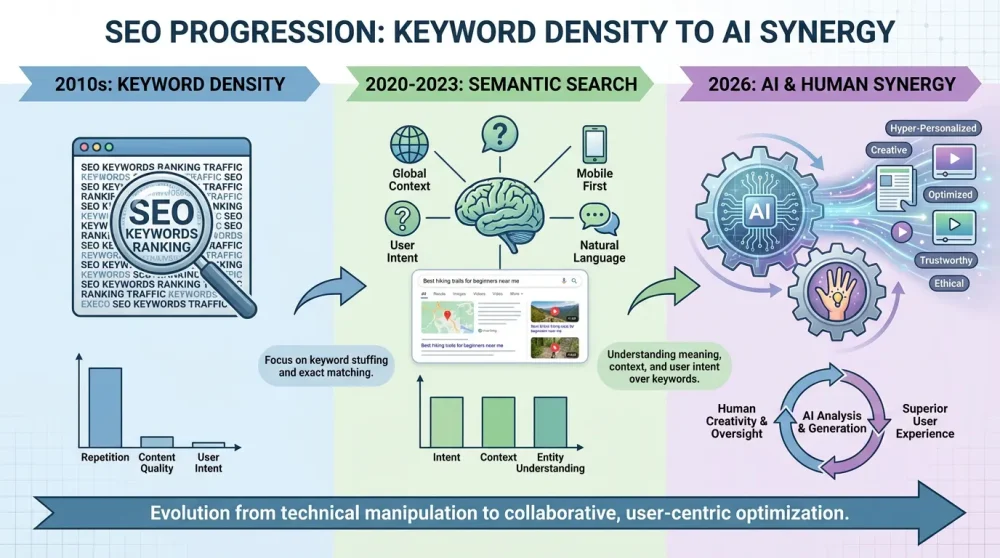
In the early days of SEO, writers could simply repeat a phrase multiple times to rank. However, search engines have become significantly smarter. By 2026, semantic search has completely replaced exact-match keyword density as the primary ranking factor. Consequently, search engines now understand the context and relationships between words, rather than just the words themselves.
This shift means that SEO copywriting skills now involve covering a topic comprehensively rather than mechanically. Therefore, writers must understand entities—people, places, and concepts—and how they relate to one another. If you fail to cover the underlying context, your content will likely disappear from the SERPs (Search Engine Results Pages), regardless of how many times you use the keyword.
The Rise of Google’s AI Overviews and SGE
The introduction of Google’s AI Overviews (formerly Search Generative Experience or SGE) changed the game for organic traffic. Because Google now synthesizes answers directly at the top of the search results, the user often gets their answer without clicking a link. As a result, zero-click searches have skyrocketed.
How to Delete a Trello Board: A Step-by-Step GuideFor an SEO writer in 2026, this means your goal is often answer engine optimization. You are writing to be the source that Google’s AI cites. Furthermore, your content needs to offer something the AI summary cannot, such as unique data, personal anecdotes, or deep expert analysis. If your content is generic, the AI will simply summarize it without sending you traffic.
Why ‘Human-in-the-Loop’ Content Wins on Trust
With the internet flooded with AI-generated content, trust has become the most valuable currency. Although AI can write faster, it often lacks nuance and verified experience. Google’s algorithms have adapted to reward content that demonstrates a clear human touch. This is where the concept of ‘Human-in-the-Loop’ becomes critical.
Readers in 2026 are skeptical. They crave authentic voices. Thus, content that feels robotic is quickly abandoned. Successful writers use AI content detection tools not just to bypass filters, but to ensure their unique voice remains intact. By injecting personal experience and subjective analysis, you signal to both users and search engines that a real person is behind the words.
How to Leave a Voicemail Without Calling on iPhone?The Shift: Writer vs. Content Optimization Specialist
The role has expanded beyond typing words into a document. Today, knowing what does a seo content writer do daily involves acting as a Content Optimization Specialist. You are expected to manage the entire lifecycle of a piece of content, from search intent analysis to final publication.
In addition to writing, you must analyze competitive gaps and update older content. Therefore, the distinction between a ‘writer’ and a ‘strategist’ has blurred. Companies willing to pay high freelance writing rates 2026 are looking for professionals who can use data to drive decisions, not just someone who can string sentences together with perfect grammar.
Core Skills for the Modern SEO Writer
Advanced Keyword Research & User Intent Mapping
Finding keywords is easy; understanding the intent behind them is the real skill. In 2026, search intent analysis goes beyond categorizing keywords as ‘informational’ or ‘transactional.’ You must map the user’s journey. For example, is the user looking for a quick answer, a deep-dive tutorial, or a product comparison?
The Best 4K Video Editing Software Free: Top Picks for 2024To excel, you need to use keyword research tools to identify not just volume, but opportunity gaps. Moreover, you must predict what the user will ask next. By answering these follow-up questions within your content, you satisfy the user’s curiosity completely, sending positive engagement signals to Google.
Prompt Engineering: Collaborating with AI Models
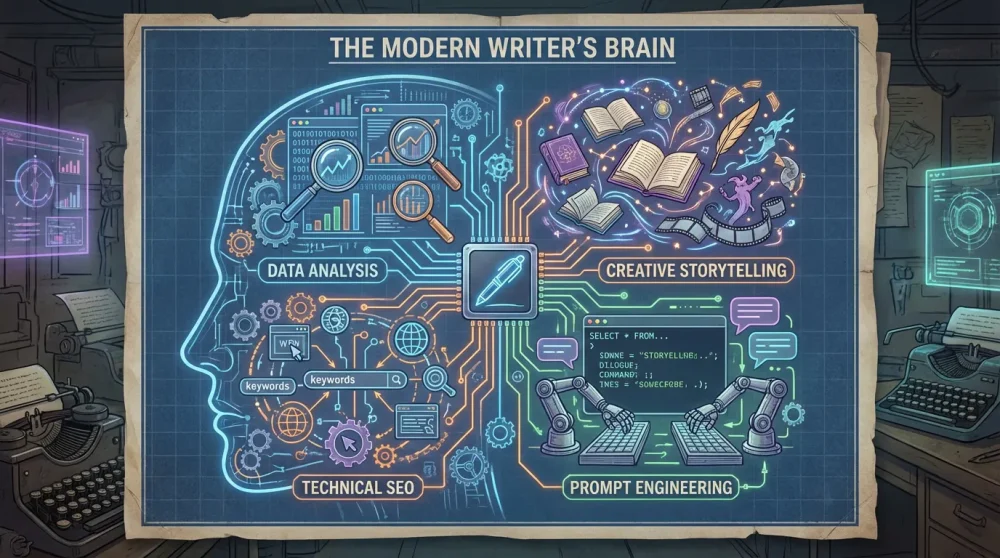
One of the newest requirements for the job is prompt engineering for writers. Since AI tools are ubiquitous, the ability to direct these tools to produce high-quality drafts is a competitive advantage. However, simply asking an AI to ‘write a blog post’ results in generic drivel.
Skilled writers know how to layer prompts to extract specific tones, structures, and data points. For instance, you might use AI to generate an outline based on topic clusters, and then refine that outline manually. Consequently, mastering this collaboration allows you to produce more content without sacrificing quality, which is essential for scaling your output.
How to Hide Google AI Overviews: Best Chrome Extensions & Methods (2026 Guide)On-Page SEO Technical Basics
You do not need to be a coder, but you must master the on-page SEO checklist. This includes knowing how to structure HTML tags properly—specifically H1, H2, and H3 hierarchies. Furthermore, you should understand how to write compelling meta descriptions that drive clicks in a crowded SERP.
In addition, understanding Schema markup basics helps search engines understand your content’s type (e.g., FAQ, Recipe, Review). Although plugins often handle this, knowing how it works allows you to troubleshoot issues. Thus, technical literacy distinguishes a professional SEO writer from a generalist copywriter.
E-E-A-T Mastery: Demonstrating Experience and Authority
Google E-E-A-T guidelines (Experience, Expertise, Authoritativeness, and Trustworthiness) remain the gold standard for ranking. In 2026, ‘Experience’ is the most critical differentiator against AI. You must demonstrate that you have actually used the product or lived the experience you are writing about.
To do this, include original photos, first-person narratives, and specific data points that an AI could not hallucinate. For example, instead of listing features of a software, describe a specific problem you solved with it. This tangible proof of experience builds trust and signals to Google that your content deserves to rank.
Data Analysis: Interpreting GSC and Analytics
Writers can no longer ignore data. You need to be comfortable looking at Google Search Console (GSC) to see which queries are bringing traffic to your pages. By analyzing this data, you can find ‘striking distance’ keywords—terms you rank for on page 2 but haven’t optimized for.
Furthermore, understanding engagement metrics like time on page and bounce rate helps you refine your content. If users are leaving quickly, your intro might be too slow. Therefore, data analysis informs your editing process, making your content more effective over time.
Content Auditing and Refreshing
Creating new content is only half the battle. A significant portion of what does a seo content writer do daily involves updating existing libraries. Content decay is real; information becomes outdated, and competitors publish better guides. Consequently, you must know how to audit old posts.
Refreshing content involves updating statistics, checking broken links, and adding new sections based on recent trends. This practice often yields quicker traffic wins than publishing new pages because the URL already has age and authority. Thus, auditing is a high-value service you can offer clients.
User Experience (UX) Writing Principles
Finally, user experience writing is paramount. Giant walls of text are intimidating on mobile devices, where most searches happen. You must format your content for readability. This involves using short paragraphs, bullet points, and clear subheadings.
In addition, use ‘jump links’ (table of contents) to help users navigate long guides. If a user cannot find the answer quickly, they will bounce back to the search results. Therefore, good SEO writing is actually good UX writing; they are two sides of the same coin.
Understanding How Search Engines Work in 2026

Crawling, Indexing, and Rendering Explained
Before you write, you must understand how Google consumes content. First, a bot ‘crawls’ the web looking for new URLs. Next, it ‘indexes’ the content, storing it in a massive database. Finally, it ‘renders’ the page to understand how it looks to a user. If your content is hidden behind complex scripts or loads too slowly, it may never be indexed properly.
For writers, this means ensuring your text is accessible. Avoid putting critical text inside images where bots might miss it. Furthermore, use clear headings to help the bot parse the structure of your argument. If the bot is confused, the algorithm will likely ignore your page.
The Algorithm: Usefulness vs. Relevance
In the past, relevance (matching the keyword) was enough. Today, the algorithm prioritizes ‘usefulness’. A page can be relevant to ‘dog training tips’ but not useful if it just repeats common knowledge. Google wants to see that your content solves the user’s problem efficiently.
This shift requires information gain—adding something new to the conversation. If your article looks exactly like the top 10 results, Google has no reason to rank it. Therefore, you must strive to provide a unique angle, new data, or a better explanation than what currently exists.
Semantic SEO and Topic Entities
Semantic SEO is the practice of optimizing for meaning rather than strings of characters. Search engines map ‘entities’—such as knowing that ‘Apple’ is a brand, a fruit, and a tech giant depending on the context. Your writing must clarify these entities.
To leverage this, you should cover topic clusters. This means creating a central ‘pillar page’ that covers a broad topic and linking it to smaller ‘cluster pages’ that explain specific sub-topics. This structure helps search engines understand that your site is an authority on the entire subject matter.
Zero-Click Searches and Answer Engine Optimization (AEO)
As mentioned earlier, answer engine optimization is vital. Many users find their answers in the snippet without clicking. While this might seem bad for traffic, appearing in these snippets builds massive brand authority. To optimize for this, provide concise, direct answers immediately after your headings.
For example, if the heading is ‘What is SEO?’, the very next sentence should be a clear definition. Do not waffle. Google’s AI looks for these direct answers to pull into the overview. Consequently, structuring your content for AEO ensures you remain visible even in a zero-click world.
The Importance of Information Gain
Google has explicitly stated the importance of information gain. This concept refers to the amount of new information a source provides compared to other sources. In an era of AI-generated content, generic articles have low information gain.
To achieve high information gain, you must conduct original research or aggregate data in a new way. For instance, instead of just stating ‘SEO is growing,’ quote specific job market stats for 2026. By providing fresh value, you insulate your content against being devalued as ‘duplicate’ or ‘unhelpful’ content.
The 2026 SEO Writing Workflow: Step-by-Step
Step 1: Niche Research and Audience Persona Building
Before typing a single word, you must understand who you are writing for. Niche research involves diving into forums, social media, and competitor blogs to see what questions real people are asking. In 2026, audience personas are more granular. You aren’t just writing for ‘marketing managers’; you might be writing for ‘marketing managers at SaaS startups struggling with retention.’
Use tools to analyze the language your audience uses. Do they say ‘soda’ or ‘pop’? Do they prefer academic studies or quick tips? Aligning your tone with your persona is crucial for engagement. Therefore, spend time listening before you start broadcasting.
Step 2: Constructing Topic Clusters and Pillar Pages
Next, plan your content architecture. Do not write in isolation. Instead, build topic clusters. Identify a broad subject (e.g., ‘Digital Marketing’) and break it down into sub-topics (e.g., ‘SEO’, ‘Email Marketing’, ‘PPC’).
Create a pillar page for the broad subject that links out to the specific articles. This internal linking structure passes authority between pages. Furthermore, it keeps users on your site longer as they click through related topics, which signals to Google that your content is valuable.
Step 3: Creating the Content Brief (AI-Assisted)
A solid brief is the blueprint of success. Use AI tools to speed up this process. You can ask an AI to extract the H2s and H3s from the top 5 ranking pages for your keyword. This gives you a baseline of what must be covered.
However, do not stop there. Add your own unique sections that competitors missed. This is where you inject information gain. Your brief should list the primary keyword, the LSI keywords, and the specific questions (FAQs) that need answering. A detailed brief prevents ‘scope creep’ and keeps the writing focused.
Step 4: Drafting: The ‘Sandwich Method’ (Human-AI-Human)
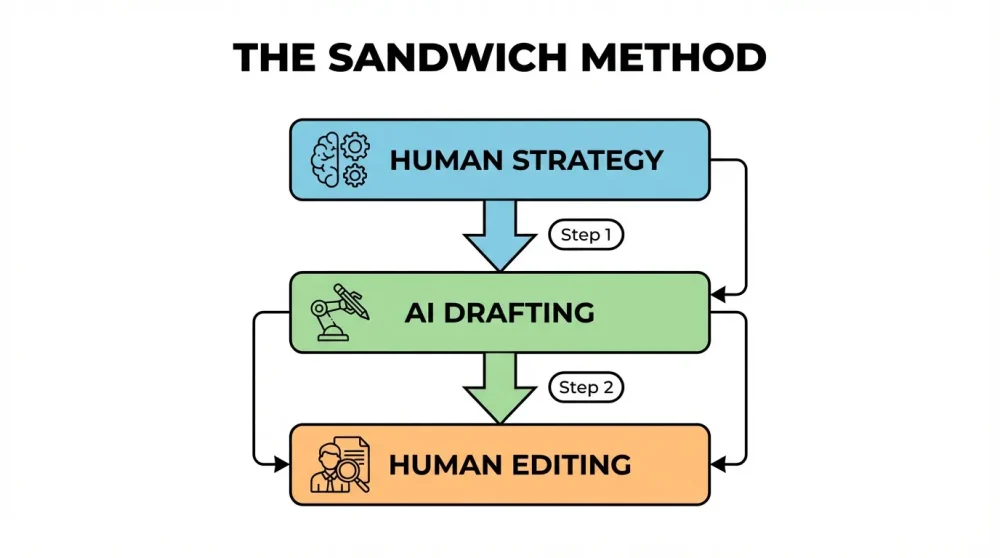
When drafting, use the ‘Sandwich Method’ to maintain quality. The top layer is Human: you define the strategy, the hook, and the unique angle. The middle layer is AI: you use tools to generate rough drafts, paragraphs, or brainstorming lists to speed up production.
The bottom layer is Human again: you heavily edit the AI output, fact-check claims, inject voice/tone, and ensure flow. This hybrid approach allows you to write at the speed of AI but with the quality of a human expert. Consequently, you produce more content without losing the ‘soul’ of the writing.
Step 5: Semantic Optimization and LSI Integration
Once the draft is written, it’s time for content optimization strategies. Use software to scan your text against top-ranking competitors. These tools will suggest LSI keywords (Latent Semantic Indexing) that you might have missed.
For example, if you are writing about ‘coffee’, LSI terms might be ‘bean’, ‘roast’, ‘barista’, and ‘brewing temperature’. Integrating these naturally helps search engines understand the depth of your content. However, avoid ‘shoehorning’ them in where they don’t fit; readability always comes first.
Step 6: Editing for Tone, Voice, and Fact-Checking
AI is notorious for ‘hallucinations’—making up facts confidently. Therefore, rigorous fact-checking is non-negotiable. Verify every statistic and quote. In addition, edit for tone. AI often sounds overly formal or repetitive.
Break up long sentences. Use contractions to sound more conversational. Read the text aloud; if you stumble, your reader will too. This editing phase is where you polish the rough diamond into a gem that represents your client’s brand voice perfectly.
Step 7: Formatting for Skimmers (The F-Pattern)
Readers online do not read; they skim. Eye-tracking studies show users follow an ‘F-Pattern’, scanning headings and the start of lines. To accommodate this, use bold text for key concepts and ensure your subheadings are descriptive.
Use bulleted lists whenever possible. Keep paragraphs under four lines. By breaking up the text, you reduce cognitive load. Thus, users are more likely to stay on the page and absorb your message, improving your time-on-page metrics.
Essential Tool Stack for SEO Writers
Keyword Research: Semrush, Ahrefs, Keywords Everywhere
To succeed, you need reliable data. Semrush and Ahrefs remain the titans of the industry in 2026. They offer deep insights into competitor strategies, backlink profiles, and keyword difficulty. While expensive, they are essential for serious SERP analysis.
For a budget-friendly option, Keywords Everywhere is a browser extension that shows volume data as you search Google. It is perfect for quick checks and finding long-tail variations on the fly. Combining a heavyweight tool with a lightweight browser extension covers all your research bases.
Content Optimization: SurferSEO, Clearscope, Frase
Writing is subjective, but optimization is objective. Tools like SurferSEO, Clearscope, and Frase analyze the top-ranking pages and give you a ‘content score’. They tell you exactly which terms to use and how often.
These tools take the guesswork out of on-page SEO. By aiming for a high score, you ensure your content is statistically similar to what Google already likes. However, treat their suggestions as guidelines, not laws. If a keyword ruins the flow of a sentence, leave it out.
AI Assistants: ChatGPT, Claude, Jasper
In 2026, not using an AI assistant is like trying to build a house without power tools. ChatGPT (latest model) is excellent for brainstorming and outlining. Claude is often preferred for its more natural, human-like writing style and large context window.
Jasper remains a strong contender for enterprise teams due to its built-in marketing templates. Whichever you choose, remember that these are assistants, not replacements. You are the pilot; they are the co-pilot.
Grammar & Style: Grammarly, Hemingway App
Clean copy is foundational. Grammarly catches typos and grammatical errors that tired eyes might miss. It also helps with tone adjustments. Meanwhile, the Hemingway App is brilliant for simplifying complex sentences.
It highlights sentences that are ‘hard to read’ in red. For SEO, lower reading levels (typically Grade 8 or 9) often perform better because they are accessible to a wider audience. Consequently, running your draft through Hemingway is a quick way to improve readability.
Plagiarism & AI Detection Checks
Finally, protect your reputation with plagiarism checkers like Copyscape or Originality.ai. Even if you wrote the content, accidental plagiarism can happen. Furthermore, many clients in 2026 require an AI content detection report.
While these detectors are controversial and sometimes inaccurate, they are a reality of the market. Being able to provide a ‘human pass’ report can be a selling point. However, the best defense against AI detection is simply having a strong, unique voice and deep E-E-A-T.
Building Your Portfolio and Authority
Choosing a Profitable Niche (FinTech, SaaS, Health, Legal)
Generalist writers are a dime a dozen. To command high freelance writing rates 2026, you must specialize. Niches like FinTech, SaaS (Software as a Service), Health, and Legal pay the most because they require technical knowledge and high accuracy.
By becoming an expert in one of these fields, you reduce the time needed for research and increase your value. Clients will pay a premium for a writer who understands the difference between ‘blockchain’ and ‘crypto’, or ‘HIPAA compliance’ and ‘GDPR’. Therefore, pick a lane and own it.
Creating Spec Pieces vs. Guest Posting
If you have no clients, you need to create your own evidence. Spec pieces (speculative samples) are articles you write for imaginary clients. Create a Google Doc, format it beautifully, and use it to demonstrate your skills. This is how to become a seo content writer with no experience.
Alternatively, guest posting on established blogs gives you a byline and a backlink. This provides social proof. When a prospect sees your name on a reputable industry site, they are far more likely to trust you than if you only have a Google Drive folder of unpublished work.
Setting Up a Personal Brand Website
You need a home base. A simple portfolio website acts as your 24/7 sales rep. It should showcase your best work, your services, and your ‘About’ page. Optimize your own site for keywords like ‘SaaS content writer’ or ‘freelance SEO copywriter’.
If you can rank your own website, you prove to clients that you can do the same for them. It is the ultimate case study. Moreover, having a professional domain email ([email protected]) looks far more professional than a generic Gmail address.
Leveraging LinkedIn and Twitter/X for Visibility
Social media is where the networking happens. LinkedIn is essential for B2B clients. Optimize your profile headline with your primary keywords. Post tips about content optimization strategies or voice search optimization to demonstrate expertise.
Twitter/X is great for connecting with other SEOs and agencies. Engage in conversations, share your wins, and be helpful. Many writers fill their pipeline purely through inbound leads from social media. Thus, treat your social profiles as active marketing channels.
Case Studies: Showing Results, Not just Words
Clients buy results, not words. If you have written a piece that ranked #1 or generated leads, turn it into a case study. Show the ‘Before’ and ‘After’ graph from Google Search Console (anonymized if necessary).
Explain the problem, your strategy (e.g., targeting long-tail variations), and the outcome. A writer who can say ‘I increased organic traffic by 40%’ is infinitely more hireable than one who just says ‘I write good blogs’. This data-driven approach positions you as an investment, not an expense.
Finding High-Paying Work
Freelance Platforms (Upwork/Fiverr) vs. Direct Pitching
Platforms like Upwork can be good for beginners, but they often become a ‘race to the bottom’ on price. While you can find high-paying gigs there, the competition is fierce. In contrast, direct pitching (cold emailing) puts you in control.
By identifying companies that fit your niche and emailing their marketing directors directly, you bypass the platform fees and the competition. It requires more effort to find the leads, but the conversion rates and pay scales are typically much higher. Therefore, aim to move away from marketplaces as you gain experience.
Agency vs. In-House Roles: Pros and Cons
Should you work for an agency or go in-house? Agencies offer variety and fast-paced learning. You will work on multiple accounts and learn digital marketing career skills rapidly. However, the workload can be high leading to burnout.
In-house roles usually offer better work-life balance and the chance to go deep into one brand’s strategy. You become the true custodian of their voice. Neither is ‘better’; it depends on your personality. Some writers even do both—working in-house and freelancing on the side.
Networking in SEO Communities and Slack Groups
Some of the best courses for seo content writing also come with private communities. Slack groups like ‘Top of the Funnel’ or ‘Superpath’ are goldmines for job postings that never hit public boards. Being active in these communities builds your reputation.
Network with SEO managers, not just other writers. SEO managers are the ones with the budget who need help executing their strategies. If you are a known entity in their circle, you will be the first person they message when they need a reliable writer.
Pricing Your Services: Per Word vs. Per Project
In 2026, pricing per word is becoming outdated, especially with AI assistance. It punishes efficiency. Instead, move toward per-project or flat-fee pricing. Charge for the value of the deliverables—the research, the optimization, the strategy—not just the typing.
For example, a fully optimized 2,000-word guide with expert quotes and schema markup might sell for $500-$1,000, regardless of how many hours it took you. This model aligns your incentives with the client’s goal: a high-quality finished product.
Contract Basics and Scope Creep Management
Never work without a contract. Your contract should clearly define the scope: word count range, number of revisions, and deadlines. ‘Scope creep’ happens when a client asks for ‘just one more small thing’ repeatedly.
If a client asks for extra work (like uploading to WordPress or sourcing images) that wasn’t in the original agreement, you should have a clause that allows you to charge extra. This protects your time and ensures the relationship remains professional and respectful.
Frequently Asked Questions
Is SEO writing still a viable career in 2026 with advanced AI?
Yes, absolutely. While AI handles generic content, human writers are needed for complex, high-stakes, and experience-based content. The role has evolved into a strategic one. Companies need humans to manage the AI, ensure factual accuracy, and inject the emotional intelligence that machines lack. Is seo writing a good career in 2026? Yes, for those willing to adapt.
What skills do I need to become an SEO writer beyond basic grammar?
Beyond grammar, you need SEO copywriting skills such as understanding user intent, prompt engineering for writers, data analysis using Google Search Console, and basic HTML/CMS knowledge. You also need to master content optimization strategies using tools like SurferSEO to ensure your content is competitive in the SERPs.
How do I optimize content for Google’s AI Overviews and Featured Snippets?
To optimize for AI Overviews and snippets, structure your content with clear, concise answers (40-60 words) immediately following a heading. Use bullet points for lists and tables for data comparisons. Focus on answer engine optimization by directly answering the ‘who, what, where, when, why’ of the topic without fluff.
Which AI tools should an SEO writer master today?
You should master a Large Language Model (LLM) like ChatGPT or Claude for drafting and brainstorming. Additionally, familiarity with optimization tools like SurferSEO or Frase is standard. Knowledge of AI detection tools like Originality.ai is also useful, though their reliability varies.
How do I build a portfolio without prior client experience?
Create ‘spec pieces’—sample articles written for imaginary clients in your target niche. Publish them on your own website, Medium, or LinkedIn. This demonstrates your writing ability and understanding of SEO formatting. This is the standard path for how to become a seo content writer with no experience.
What is the difference between SEO copywriting and content writing?
SEO copywriting is designed specifically to convert traffic and rank in search engines (e.g., landing pages, sales pages). Content writing is broader and often focuses on education and brand awareness (e.g., blog posts, white papers). However, in 2026, the lines are blurred, and most roles require a mix of both.
How much can an SEO content writer earn in 2026?
SEO content writer salary 2026 varies widely. Beginners might earn $0.05-$0.10 per word. Experienced specialists or subject matter experts (e.g., legal/medical) can command $0.50-$1.00+ per word or project fees of $500-$1,500 per article. Strategists and editors generally earn more than pure writers.
Conclusion
Image Prompt: A motivating image of a writer standing on a mountain peak looking out over a digital city labeled ‘2026’, holding a flag that says ‘Content Architect’.
Alt Text: Conclusion of the guide on how to be an SEO content writer in 2026.
Learning how to be a seo content writer in 2026 is about embracing the hybrid nature of the role. The days of simply churning out words are over. Today, you are a strategist, a data analyst, and a creative director all in one. By mastering content optimization strategies, understanding semantic search, and leveraging AI without losing your human touch, you can build a future-proof career.
Remember, tools like keyword research tools and AI assistants are just that—tools. The real value comes from your ability to connect with the reader, demonstrate Google E-E-A-T guidelines, and provide genuine insight. Whether you are looking for freelance freedom or a stable digital marketing career, the opportunities are vast for those who are willing to learn. Start building your portfolio today, stay curious, and keep writing.