
Hello, everyone! I’m excited to share some incredible news about a new quantum chip developed by Google called Willow. This chip is a major breakthrough in technology and brings us closer to building powerful quantum computers that can tackle complex problems we face today. Let’s dive into what makes Willow so special and why it matters.
What is Quantum Computing?
Before we explore Willow, let’s understand what quantum computing is.
- Regular Computers vs. Quantum Computers: Traditional computers use bits to process information, where each bit can be either a 0 or a 1. In contrast, quantum computers use qubits. Qubits are unique because they can represent 0, 1, or both at the same time, thanks to a property called superposition. This ability allows quantum computers to perform many calculations simultaneously, making them incredibly powerful for certain tasks.
- Entanglement: Another important feature of qubits is entanglement. When qubits become entangled, the state of one qubit is linked to the state of another, no matter how far apart they are. This means that changing one qubit will instantly change its entangled partner, allowing for faster and more complex computations.
What Makes Willow Unique?
1. Breakthrough in Error Correction
One of the biggest challenges in quantum computing is dealing with errors that occur when qubits interact with their environment. These errors can quickly multiply as more qubits are used, making it difficult to perform accurate calculations.
- Exponential Error Reduction: Willow introduces a new way to reduce errors significantly as it scales up. Google tested Willow with different sizes of qubit arrays (3×3, 5×5, and 7×7 grids), and each time they added more qubits, they found that the error rates decreased exponentially. This achievement is known as being “below threshold,” meaning that as they increase the number of qubits, the system becomes more reliable and capable of performing quantum operations without significant errors.
2. Incredible Speed
Willow has demonstrated astonishing performance in calculations:
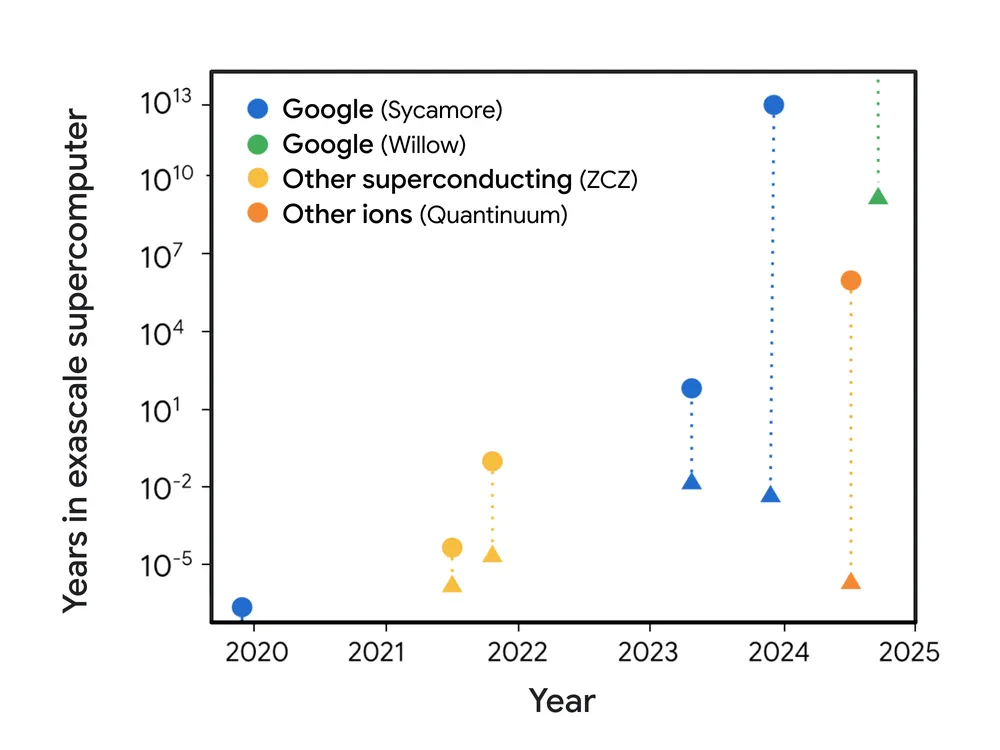
- Superfast Computation: In a benchmark test called random circuit sampling (RCS), Willow completed a complex computation in less than five minutes. To put this in perspective, a supercomputer—one of the fastest classical computers available—would take about 10 septillion years (that’s 10 followed by 24 zeros!) to finish the same task. This shows that quantum computers like Willow can solve problems much faster than classical computers ever could.
3. Real-World Applications
Google isn’t just focused on making chips; they are also working on developing algorithms that can solve real-world problems:
iOS 13 Dark Mode: Is it Bad for Your Eyes?- Potential Fields: The breakthroughs made with Willow could revolutionize various fields, including:
- Medicine: Discovering new drugs and treatments by simulating molecular interactions.
- Energy: Optimizing energy storage and improving battery technology for electric vehicles.
- Artificial Intelligence (AI): Enhancing machine learning processes and data analysis.
Breaking Down the Achievements
Exponential Error Reduction Explained
- Testing Qubits: Google’s team tested different configurations of qubits to see how well they performed when scaled up. They found that as they increased the number of qubits, they were able to cut the error rate in half each time. This means that instead of errors multiplying as more qubits were added, the errors decreased, showing that Willow is more reliable as it grows.
- Real-Time Error Correction: This accomplishment also includes real-time error correction, which means that errors are corrected quickly during computations before they can ruin the results. It’s crucial because if errors aren’t fixed fast enough, they can spoil the entire calculation.
Random Circuit Sampling (RCS) Benchmark
- What is RCS?: RCS is a benchmark used to evaluate how well a quantum computer performs compared to classical computers. It tests whether a quantum computer can solve problems that classical computers struggle with.
- Willow’s Performance: By using RCS, Google has consistently tracked progress across different generations of quantum chips. Willow’s performance on this benchmark demonstrates its ability to process information in ways classical computers cannot replicate.
What’s Next for Willow?
The team at Google is now setting their sights on even bigger challenges:
- Useful Computations: They aim to demonstrate a “useful, beyond-classical” computation using Willow that has real-world applications. While they’ve successfully run benchmarks that measure performance against classical computers, the next step is to develop algorithms that can tackle practical problems.
- Collaboration and Learning: Google invites researchers, engineers, and developers to join them on this exciting journey. They have provided open-source software and educational resources, including courses on platforms like Coursera, where developers can learn about quantum error correction and contribute to creating new algorithms.
Why Does This Matter?
You might be wondering why all this is important:
- Transforming Technology: Quantum computing has the potential to change how we approach many scientific and practical challenges. It could lead to breakthroughs in medicine, energy efficiency, and artificial intelligence.
- Future Applications: Many future applications that could change our lives—like discovering new medicines or designing more efficient energy sources—will not be feasible on traditional computers. They require the power of quantum computing to unlock their full potential.
Conclusion
Willow is not just an advanced chip; it represents a significant step toward realizing the true potential of quantum computing. With its groundbreaking achievements in error correction and speed, we are closer than ever to building powerful quantum computers that can solve complex problems facing society today.
Protecting Your Privacy Online: Key StepsAs we continue this journey into the world of quantum technology, who knows what amazing discoveries await us in the future? The possibilities are endless!