

The cybersecurity landscape has shifted. For years, we heard warnings about the “quantum apocalypse”—a future where supercomputers could shatter the encryption protecting the world’s data. That future is no longer a distant sci-fi plot; it is a present-day business risk.
If you own a small business, you might think you’re too small to be a target for nation-state actors armed with quantum computers. You are wrong. The threat isn’t just about who can decrypt your data tomorrow; it’s about who is stealing it today.
This is the ultimate guide to Quantum-Resistant VPNs (Post-Quantum Cryptography or PQC). We will cut through the academic jargon and give you a practical, step-by-step strategy to secure your business against the “Harvest Now, Decrypt Later” threat.
The “Q-Day” Threat: Why Small Businesses Must Act Now
You may have heard of Q-Day—the theoretical date when quantum computers become powerful enough to break standard encryption (like RSA-2048 and ECC) instantly. While estimates for a full-scale Q-Day range from 2030 to 2035, the danger to your business started years ago.
The “Harvest Now, Decrypt Later” (HNDL) Attack
This is the single most critical concept for every business owner to understand.
Attackers are currently scraping encrypted traffic from the internet on a massive scale. They cannot read it yet. Instead, they store it in massive data centers, waiting for quantum computers to mature. Once the technology arrives, they will retroactively decrypt everything they collected.
Does your business hold data that will still be sensitive in 5-10 years?
- Yes: Employee social security numbers, trade secrets, proprietary code, long-term contracts, or legal correspondence.
- No: Lunch orders or ephemeral chat logs.
If you answered “Yes,” your data is already at risk. A Quantum-Resistant VPN is your first line of defense against this retrospective exposure.

What is a Quantum-Resistant VPN?
A Quantum-Resistant VPN (or PQC VPN) uses advanced mathematical algorithms that cannot be solved by quantum computers.
Unlike traditional encryption which relies on factoring large numbers (a task quantum computers excel at), PQC relies on complex problems like Lattice-based cryptography. These problems are incredibly difficult for both classical and quantum computers to solve.
The NIST Standard: The Gold Seal of Security
In August 2024, the National Institute of Standards and Technology (NIST) finalized the first set of post-quantum encryption standards. When choosing a VPN for your business, you must look for compliance with these specific algorithms:
| Algorithm Name | Technical Code | Purpose | Status |
|---|---|---|---|
| ML-KEM (formerly Kyber) | FIPS 203 | General Encryption (Key Encapsulation) | APPROVED & ESSENTIAL |
| ML-DSA (formerly Dilithium) | FIPS 204 | Digital Signatures | APPROVED |
| SLH-DSA (formerly SPHINCS+) | FIPS 205 | Digital Signatures (Backup) | APPROVED |
Crucial Advice: If a VPN provider claims to be “Quantum-Ready” but does not mention ML-KEM, Kyber, or NIST FIPS 203, they are likely using experimental or outdated tech. Avoid them.
Top Quantum-Resistant VPNs for SMBs (2026 Ranked)
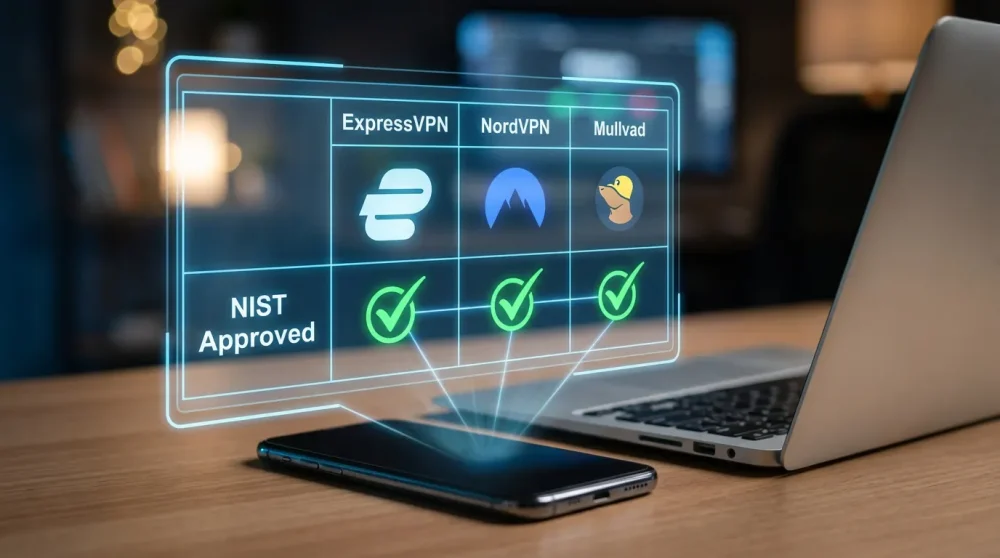
For a small business, you don’t have the time to build a custom Linux server. You need “set and forget” security. Below are the top providers that have successfully implemented PQC defaults.
1. ExpressVPN (Best for “Set It and Forget It”)
ExpressVPN was one of the first to market with its Lightway protocol, which now includes post-quantum protection by default.
- Protocol: Lightway (proprietary, open-source core).
- Algorithm: Uses a Hybrid approach (Classic Elliptic Curve + ML-KEM/Kyber). This is the safest method; if the new quantum algorithm has a bug, the classic one still protects you.
- Performance: Negligible impact. Handshakes take ~15-20ms longer, but throughput (download speed) remains unaffected.
- Why for SMBs? It’s on by default. Your employees don’t need to toggle settings.
2. NordVPN (Best for Features & Speed)
NordVPN has rolled out PQC support across all major platforms (Windows, macOS, Linux, Android, iOS) as of 2025.
- Protocol: NordLynx (built on WireGuard).
- Algorithm: ML-KEM (Kyber).
- Configuration: Often requires a toggle switch in settings under “Connection” or “Protocol.”
- Why for SMBs? Excellent speed and includes additional business features like “Meshnet” for secure remote file sharing.
3. Mullvad VPN (Best for Privacy Purists)
Mullvad is a favorite among security experts. They implemented PQC on WireGuard using a clever workaround before WireGuard officially supported it.
- Protocol: WireGuard (with custom PQC wrapper).
- Algorithm: Classic McEliece + ML-KEM (split tunnel approach).
- Cost: Flat rate (€5/month), no contracts.
- Why for SMBs? If you have a small, tech-savvy team (e.g., developers) who value transparency and open-source code above all else.
Does “Quantum-Safe” Slow Down Your Internet?
This is the #1 fear for business owners. You cannot afford to have Zoom calls drop or large file transfers stall.
The Reality: The performance impact is minimal to non-existent for daily use.
- Throughput (Speed): Unaffected. Once the secure tunnel is established, the data encryption (usually AES-256) remains the same. AES-256 is already considered quantum-resistant.
- Latency (Ping): Slight increase. The “handshake” (the initial connection) involves exchanging larger keys.
- RSA Key Size: ~0.2 KB
- ML-KEM Key Size: ~1.2 KB
- Impact: A 1.2 KB key still fits inside a single standard TCP packet (~1.5 KB), meaning there is no fragmentation or significant delay. You might notice a connection takes 0.5 seconds to start instead of 0.3 seconds.
Verdict: Your employees will not notice the difference.
Implementation Guide: How to Secure Your Business Today
You don’t need an IT department to roll this out. Follow this 4-step checklist.
Step 1: Audit Your Data “Shelf Life”
Identify which data needs long-term protection.
- Action: Label folders or drives containing Intellectual Property (IP), financials, or PII (Personally Identifiable Information) as “Critical – Long Term.”
Step 2: Update Your VPN Client
If you already use NordVPN, ExpressVPN, or Mullvad, you might technically have the feature but not be using it.
- Action: Instruct all employees to update their VPN app to the latest version immediately. PQC features are often included in version updates from late 2024/2025 onwards.
Step 3: Enforce the Correct Protocol
PQC is often tied to specific protocols. It won’t work if an employee is using an old “OpenVPN (UDP)” connection without the right patches.
- ExpressVPN Users: Set protocol to “Automatic” or “Lightway.”
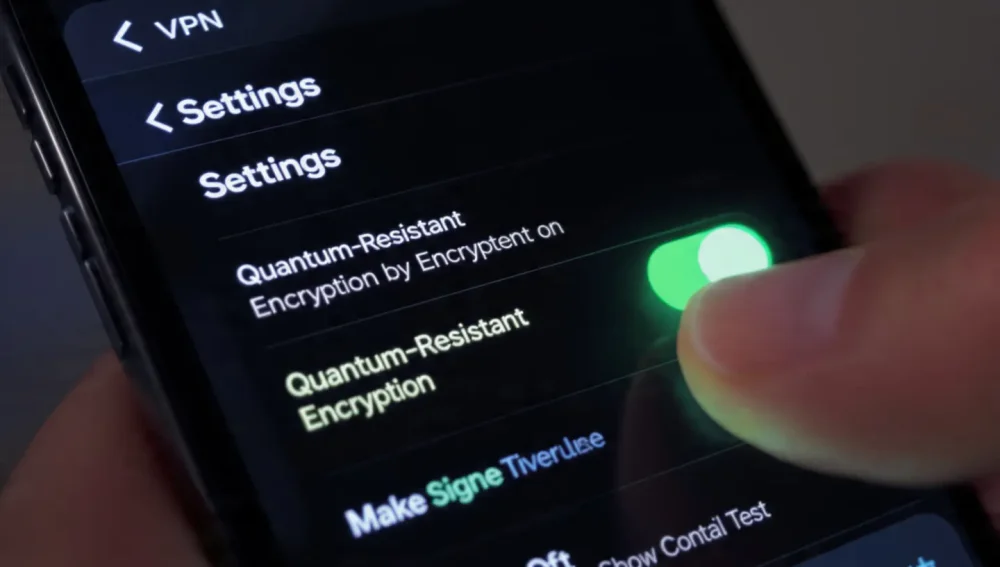
- NordVPN Users: Set protocol to “NordLynx.” Go to Settings > Connection and ensure “Quantum-Resistant” is toggled ON (if available as a separate switch).
- Mullvad Users: Use WireGuard. Verify “Quantum-resistant tunnel” is set to “Automatic” or “On” in VPN settings.
Step 4: Verify the Connection
Don’t just trust the settings.
- Action: Most providers now have a “Status” screen. Look for indicators like “Quantum-Safe,” “PQC Enabled,” or “Lightway (UDP/TCP) + ML-KEM.”
Beyond the VPN: A Mini-PQC Checklist for SMBs
A VPN secures your data in transit. But what about the rest of your stack?
- Secure Your Browser: Ensure browsers are updated. Chrome and Firefox have added support for hybrid post-quantum key exchange (X25519Kyber768) for HTTPS connections.
- Encrypted Messaging: Use Signal. They upgraded to the PQXDH (Post-Quantum Extended Diffie-Hellman) protocol in late 2023. It is currently the gold standard for secure business communication.
- Cloud Storage: Verify if your cloud provider (Google Drive, Dropbox, OneDrive) supports encryption at rest. While they handle the server-side PQC transition, you should encrypt sensitive files before uploading them using tools like Veracrypt (AES-256).
Frequently Asked Questions (FAQ)
No. For the major providers listed (Express, Nord, Mullvad), quantum-resistance is a feature update, not a new pricing tier. It is included in their standard business and consumer plans.
The deadline was yesterday. Since HNDL attacks are retroactive, every day you transmit data using classical encryption is a day you create potentially compromised records. Switch to a PQC-enabled VPN protocol immediately.
No. AES-256 (symmetric encryption) is considered quantum-resistant. Grover’s Algorithm suggests that quantum computers could weaken it, effectively halving its strength to AES-128, which is still incredibly secure. The real vulnerability is in the Key Exchange (RSA/Elliptic Curve)—how your computer and the server agree on that AES key. That is what PQC (ML-KEM) fixes.
Nothing happens immediately. Your internet will work fine. However, your encrypted traffic recorded today becomes a ticking time bomb. When quantum computers become viable, that traffic becomes readable plain text to anyone who harvested it.
If you process credit cards, hold customer address lists, or have private email correspondence, yes. The “Harvest Now, Decrypt Later” attacks are automated. They scoop up everything. You don’t want your 2026 tax returns or customer database leaking in 2032.
Not by default. Standard WireGuard uses the ChaCha20-Poly1305 and Curve25519 algorithms, which are not quantum-resistant. You must use a VPN provider (like Mullvad or NordVPN’s NordLynx) that has added a custom PQC layer on top of WireGuard.