

The “ETF Era” of 2024 was a necessary bridge, bringing institutional liquidity to Bitcoin and Ethereum. But as we move deep into 2025 and look toward 2026, a massive shift is occurring in the crypto asset management landscape. The narrative is moving from Passive Exposure (ETFs) to Active, Composable Yield (Onchain Vaults).
For the sophisticated investor, holding a static BlackRock iShares Bitcoin Trust (IBIT) is no longer sufficient. Why pay a management fee for a dormant asset when Onchain Smart Vaults offer auto-compounding yields, tax-efficient rebalancing, and direct integration into the DeFi economy?
In this strategic analysis, we dissect why “Decentralized Token Folios” (DTFs) and Smart Vaults are becoming the dominant standard for 2026, analyzing the roadmaps, tokenomics, and technology of the protocols leading this charge.
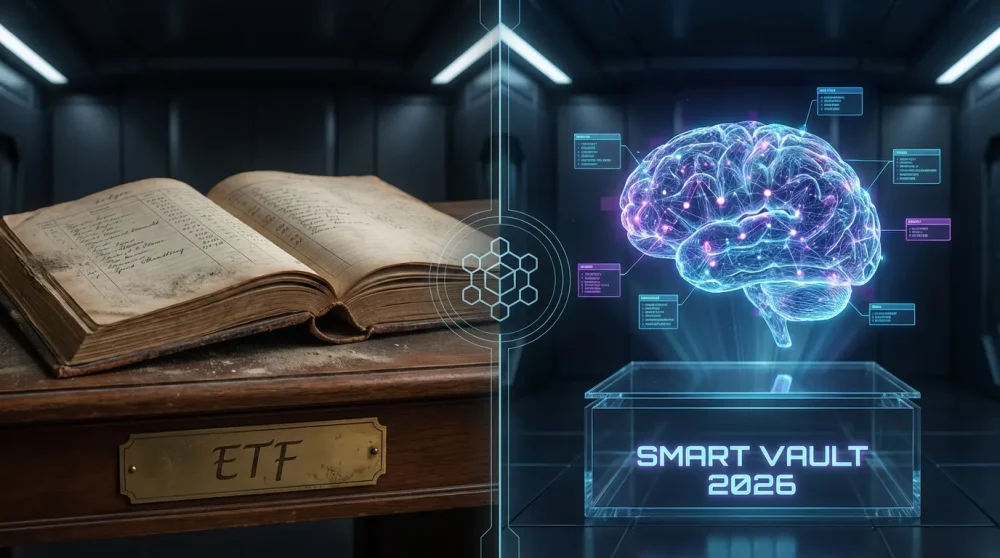
The “DTF” Thesis: The Evolution of the Index Fund
By 2026, the concept of the “ETF” is being challenged by the Decentralized Token Folio (DTF). Unlike traditional ETFs, which are custodial and settle T+1 or T+2, onchain vaults offer:
- Atomic Settlement: Instant entry and exit, 24/7.
- Programmability: Assets in a vault can be used as collateral in lending protocols (e.g., Aave, Morpho) while still earning yield.
- Proof of Reserves: Real-time auditability on Etherscan, eliminating the “paper Bitcoin” risk.
2025-2026 Market Leaders in Onchain Asset Management
The following protocols are not just “yield farms”; they are the “Vanguard” and “Fidelity” of the Web3 era.
1. Enzyme Finance (MLN) – The Institutional Infrastructure Layer
Enzyme has evolved from a simple asset management tool into a robust “Vaults-as-a-Service” infrastructure. Their 2025 “Onyx” update positioned them as the go-to backend for institutions launching compliant onchain funds.
- 2025-2026 Roadmap Focus:
- Cross-Chain Deposits: Seamlessly accepting deposits from Arbitrum and Optimism into Ethereum Mainnet vaults.
- Institutional Whitelisting: “Permissioned Vaults” that allow traditional funds to operate onchain while remaining compliant with KYC/AML laws.
- Token Utility (MLN): The MLN token model has shifted towards a “buy-and-burn” mechanism funded by protocol fees, directly linking AUM growth to token scarcity.
- Official Website: Enzyme Finance
2. dHEDGE (DHT) – The “Social Trading” Powerhouse
dHEDGE has successfully pivoted to capture the “Manager-Agnostic” market. Through their integration with Toros Finance, they offer automated leverage tokens (e.g., “3x Long ETH”) that function like leveraged ETFs but are fully transparent and onchain.
- 2025-2026 Roadmap Focus:
- Flat Money Integration: Expanding their stablecoin yield products to offer inflation-resistant returns.
- Automated Risk Manager: Deployment of AI agents that automatically hedge vault exposure during high-volatility events (flash crashes).
- Token Utility (DHT): Stakers of DHT receive a portion of the performance fees generated by the top-performing vaults, creating a “Real Yield” dividend.
3. Sommelier Finance (SOMM) – The Off-Chain Intelligence Layer
Sommelier differentiates itself by using the Cosmos SDK to run complex off-chain computations (like machine learning models) that execute trades on-chain on Ethereum. This allows for “Dynamic Cellars” that can react to market conditions faster than standard smart contracts.
- 2025-2026 Roadmap Focus:
- Layer 2 Expansion: Aggressive deployment of “Real Yield” Cellars on Arbitrum and Base to minimize gas fees for retail users.
- Multi-Asset Rebalancing: Introduction of vaults that dynamically rotate between ETH, BTC, and Stablecoins based on volatility indicators.
- Token Utility (SOMM): Governance validators stake SOMM to secure the bridge and execute strategy updates; in return, they earn bridging fees.
4. Index Coop (INDEX) – The BlackRock of Web3
Index Coop remains the leader in “structured products.” Their DeFi Pulse Index (DPI) was the pioneer, but their 2026 focus is on “High Yield” indices (hyETH, icUSD) that compete directly with money market funds.
- 2025-2026 Roadmap Focus:
- Leverage Suite Expansion: Launching granular leverage tokens (e.g., BTC2x, ETH2x) on low-cost L2 chains.
- RWA Integration: Creating hybrid indices that mix onchain crypto yields with tokenized U.S. Treasury bills.
- Token Utility (INDEX): Governance power over the “methodology” of indices—essentially controlling the rebalancing logic of hundreds of millions in assets.
5. Beefy (BIFI) – The “Set and Forget” Yield Optimizer
Beefy remains the gold standard for auto-compounding. While not an “active manager” in the trading sense, its vaults automatically harvest rewards and reinvest them, maximizing APY without user intervention.
- 2025-2026 Roadmap Focus:
- Cross-Chain Zap: One-click deposit from any chain into any vault (e.g., pay with Polygon USDC to enter an Arbitrum ETH vault).
- Concierge Services: specialized vaults for high-net-worth individuals requiring lower-risk, stablecoin-heavy strategies.
- Token Utility (BIFI): One of the few tokens where 100% of protocol revenue is distributed to BIFI stakers.
Comparison: Traditional ETF vs. Onchain Smart Vault (2026 Standard)
The gap between “Legacy Finance” (TradFi) and “Decentralized Finance” (DeFi) has widened in terms of utility.
| Feature | Traditional Crypto ETF (e.g., IBIT) | Onchain Smart Vault (e.g., dHEDGE/Enzyme) |
|---|---|---|
| Trading Hours | 9:30 AM – 4:00 PM (Mon-Fri) | 24/7/365 (Always Open) |
| Custody | Third-Party (Coinbase Custody, etc.) | Self-Custody (Smart Contract) |
| Settlement | T+1 or T+2 Days | Atomic / Instant |
| Yield | None (unless specifically a staking ETF) | Auto-Compounding (Staking + DeFi Yields) |
| Composability | None (Assets sit in a brokerage account) | High (Vault tokens can be collateral) |
| Fees | 0.25% – 1.5% Management Fee | Performance-based (You only pay if you profit) |
| Transparency | Quarterly Reports | Real-Time Block Explorer |
Futuristic Prediction: The “AI Fund Manager” of Late 2025
As we move toward late 2025, the next frontier is AI-Agent Governance.
We are already seeing early experiments where protocols like Sommelier and Enzyme allow “AI Strategists” to manage vaults. By 2026, we predict:
- Robo-Advisor DAOs: You will not deposit into a vault managed by a human, but by an LLM (Large Language Model) trained on 10 years of onchain data.
- Personalized “DTFs”: Wallets will generate custom “indices” for you on the fly based on your risk tolerance, instantly creating a mini-vault just for your wallet.
- Regulatory “Wrappers”: RWA (Real World Asset) vaults will automatically handle tax withholding at the smart contract level, making them compliant by code.
Detailed FAQ: Navigating the Onchain Vault Landscape
“Safe” is relative. ETFs protect you from smart contract risk but expose you to custodial and regulatory risk (e.g., asset seizure). Onchain vaults eliminate custodial risk but require you to trust the code. Always check if a vault is Audited (e.g., by OpenZeppelin or Trail of Bits) and if the protocol has a Bug Bounty program.
By 2026, on-ramps have improved significantly. Most major wallets (MetaMask, Phantom, Rabin) now allow you to go directly from Fiat -> Stablecoin -> Vault in one transaction. However, the underlying asset is always crypto.
This is the “Auto-Compound” advantage. In many jurisdictions, auto-compounding vaults (like Beefy) do not trigger a taxable event until you withdraw, unlike ETFs which may distribute taxable dividends. Disclaimer: Consult a tax professional.
Index Coop or Beefy. Index Coop offers simple “buy and hold” tokens (like DPI) that require no maintenance. Beefy is excellent for putting idle assets to work with a “set and forget” mentality.
Disclaimer: This article is for informational purposes only and does not constitute financial advice. The crypto market is volatile. Always do your own research (DYOR) before using any protocol.