

If the next iPhone features a built-in holographic projector, it would transform mobile interaction from flat screens to immersive 3D environments. This hardware would enable lifelike 3D FaceTime calls and tabletop gaming, effectively shrinking the Apple Vision Pro’s spatial computing power into a pocket-sized device.
Let’s be honest: the smartphone has become a bit of a snooze-fest lately. Every September, we tune into the Apple Keynote hoping for magic, and every year we get a slightly faster chip, a marginally better camera, and maybe a new shade of titanium that looks suspiciously like the old shade of titanium. We’ve reached the limit of smartphone popularity. But imagine for a second that Tim Cook stands on that stage, pauses, and says, “One more thing,” as a shimmering, three-dimensional map of Mars rises six inches off the surface of an iPhone 17 Pro.
I’m not talking about the gimmicky “3D” screens of the early 2010s that gave everyone a headache. I’m talking about true, volumetric holography. We are standing on the precipice of a shift from looking at our digital lives to interacting with them in physical space. If Apple Inc. pulls this off, it won’t just be a new feature; it will be the death knell for the glass rectangle as we know it.
The Evolution of Apple Displays: From Retina to Holographic
We’ve come a long way since the original iPhone’s grainy 163 ppi display. I remember the absolute shock of the iPhone 4’s Retina Display. Suddenly, the pixels disappeared. We moved into the OLED era with the iPhone X, giving us those deep, infinite blacks and vibrant colors that make Instagram look better than real life. But even with ProMotion and 2,000 nits of brightness, we are still trapped behind a two-dimensional pane of glass.
The transition to holography is the natural endgame of Apple’s display evolution. For years, Apple has been obsessed over “immersion.” They want the device to disappear.How to Handle Stage Fright Public Speaking: 6 Easy Tips
- Retina hid the pixels.
- OLED hid the backlight.
- Holography hides the screen itself.
By moving the interface into the air above the device, Apple solves the fundamental limitation of mobile tech: screen real estate. You no longer need a 6.7-inch Max model to see a complex spreadsheet or a sprawling game map if the data can float in the 3D space around you. We are shifting from a window to a world.
Understanding the iPhone Holographic Projector Technology
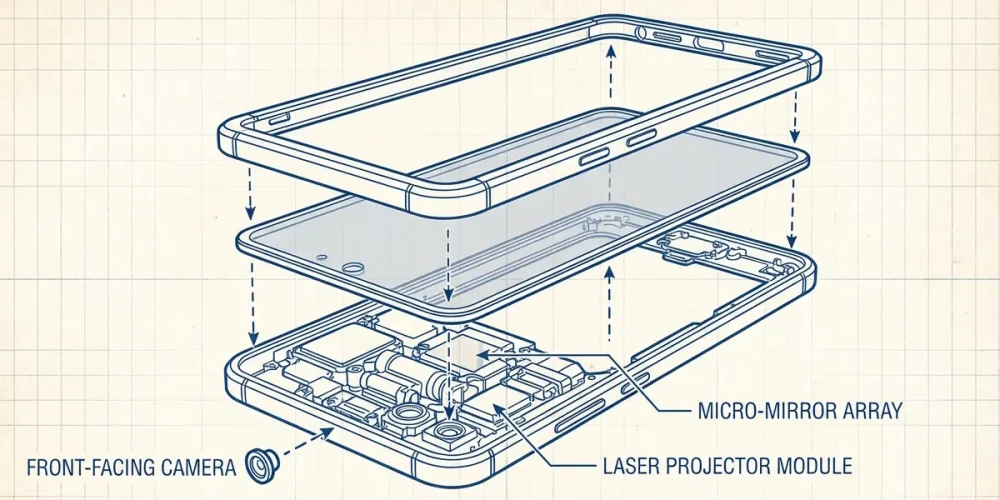
So, how would this actually work? We aren’t talking about Princess Leia-style blue flickering beams (though that would be cool). The most likely path involves Silicon Photonics and a massive advancement in diffractive optical elements (DOEs).
Instead of a traditional projector that requires a wall to hit, a holographic iPhone would likely utilize a “Light Field Display.” This involves a specialized layer sitting atop the OLED panel that directs light at dozens of different angles simultaneously. To your eyes, these light rays converge in mid-air to create a solid-looking object.
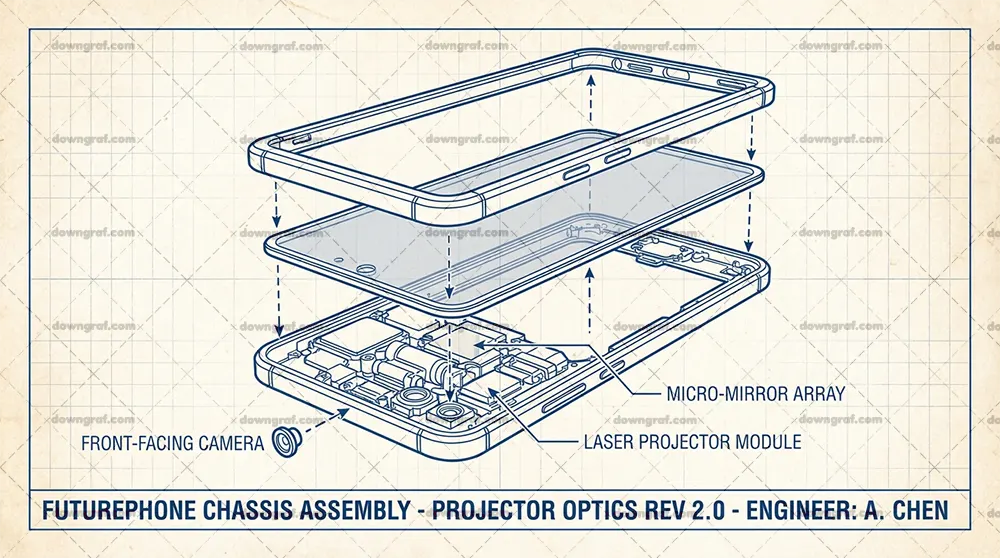
Another possibility—and one that fits Apple’s recent patent filings—is the use of a nano-lens array combined with the existing Face ID sensors. By tracking exactly where your eyes are, the iPhone can project a “steerable” image that looks perfectly 3D to you, even if you move your head.10 Interactive Ideas for a Presentation That Wow Any Audience
- Micro-LED Integration: Using incredibly small, bright pixels to punch through ambient sunlight.
- Nano-optics: Microscopic lenses that bend light into volumetric shapes.
- Spatial Temporal Multiplexing: Flickering images so fast that the human eye perceives a solid 3D object.
3D FaceTime: A New Era of Virtual Connection
Video calls are exhausting. We’ve all felt “Zoom fatigue.” Part of the reason is that our brains have to work overtime to interpret a 2D image as a 3D person. We lose the nuances of depth, the subtle lean-in, and the feeling of shared space.
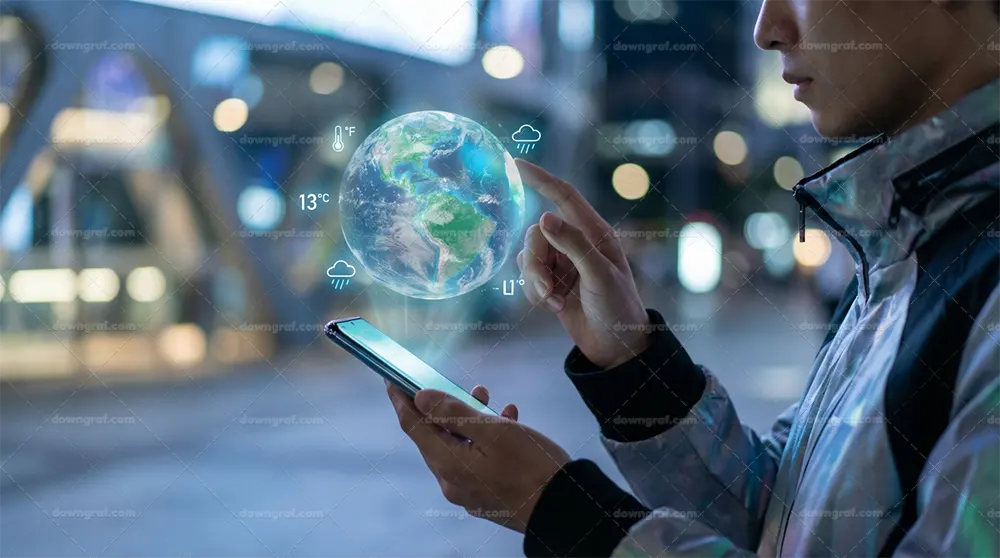
Imagine a 3D FaceTime call where your best friend or your mom isn’t just a face in a box, but a volumetric “bust” sitting on your coffee table. You could walk around them. You could see the depth of their expression. It brings a level of intimacy that a flat screen simply cannot replicate.
This isn’t just about fun; it’s about Spatial Computing for the masses. While the Apple Vision Pro is a masterpiece, wearing a “ski mask” for a 20-minute chat is a big ask. Bringing that same “Persona” technology—the digital avatars Apple has already perfected—to the iPhone via a holographic projector makes the tech invisible and frictionless.
How Spatial Audio and Holograms Enhance Communication
The magic happens when you pair 3D visuals with Spatial Audio. If you move to the left of a holographic caller, the audio should shift to your right ear. Apple has already laid the groundwork for this with the AirPods Pro and Max.10 Secret Tips on How to Get Audience Attention in a Speech Quickly
- Directional Sound: The iPhone’s speakers use beamforming to “throw” sound so it appears to come from the hologram.
- Environmental Awareness: Using the microphone to analyze room acoustics, making the hologram’s “voice” sound like it’s actually in the room with you.
- Haptic Integration: Imagine a “tap” on the screen causing a ripple in the hologram. It bridges the gap between digital and physical.
Gaming Reimagined: Playing in Three Dimensions
This is where things get truly wild. Mobile gaming is currently dominated by “thumb-on-glass” mechanics. It’s functional, but it’s limited. A holographic iPhone turns your phone into a portable game console that uses the entire room as a stage.
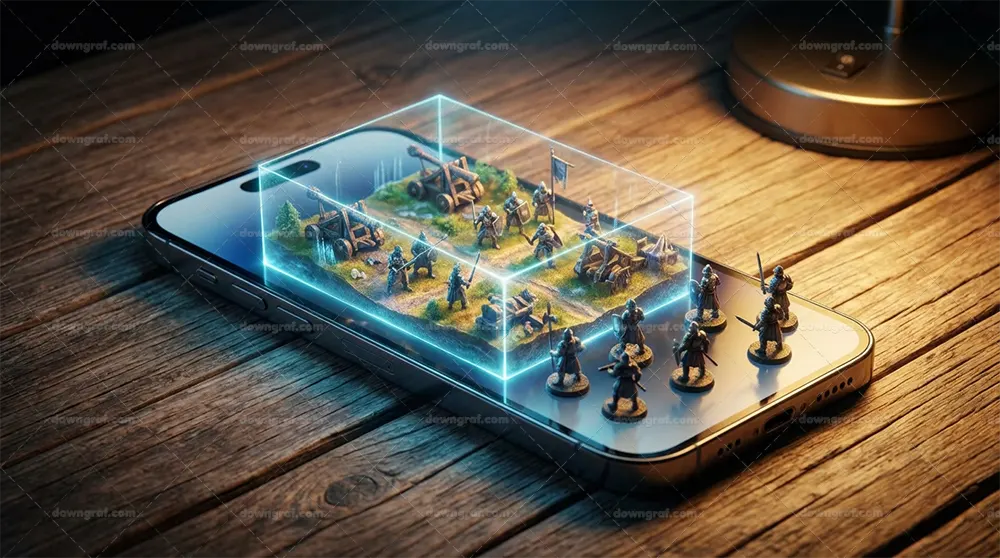
Think about a tabletop strategy game like Warhammer or Civilization. Instead of squinting at a tiny screen, the battlefield is projected onto your dining room table. You can physically move your phone around the “map” to see different angles, or use gestures in the air to command troops.
The Role of LiDAR and Neural Engine in Holographic Rendering
To make a hologram look like it’s actually “sitting” on a table and not just floating ghost-like through a chair, you need incredible spatial awareness. This is where the LiDAR scanner comes in.
- Room Mapping: The LiDAR sensor shoots out millions of laser points to create a 3D mesh of your environment.
- Occlusion: The Neural Engine uses this mesh to make sure that if a cat walks behind your holographic game, the game is hidden behind the cat.
- Real-time Lighting: The iPhone’s cameras analyze the light in your room so the hologram casts a realistic shadow on your desk.
Without the A-series chips—specifically the heavy lifting of 3D Rendering and AI processing—these holograms would look like flickering 1990s arcade sprites. We need the power of a desktop computer in our pockets to drive these visuals at 120Hz.What if AI could recreate any Hollywood blockbuster but with you as the lead actor in seconds?
Technical Hurdles: Battery Life, Heat, and Form Factor
Now, I have to be the bearer of bad news for a moment. As much as I want this, the laws of physics are a stubborn bunch. Projecting light into the air requires an immense amount of energy.
- The Battery Problem: Current iPhone batteries are already stressed by 5G and high-brightness OLEDs. Driving a laser-based holographic array could cut battery life down to a few hours. Apple would need a breakthrough in solid-state batteries or extreme efficiency gains in their silicon.
- Thermal Throttling: Projectors get hot. Anyone who has used a pocket projector knows they usually have a loud fan. A fanless iPhone trying to project a 3D 3D FaceTime call would likely turn into a pocket-sized space heater within ten minutes.
- The Form Factor: We like our phones thin. Adding a complex optical assembly for holography usually means adding bulk. Would you accept an iPhone that’s twice as thick for the sake of 3D? Most people wouldn’t.
Apple’s challenge is to shrink these components down to the size of a grain of rice. It’s a feat of engineering that might require Silicon Photonics—using light instead of electricity to move data within the chip itself—to reduce heat and increase speed.
Patent Analysis: What Apple is Actually Developing
If you think this is all sci-fi daydreaming, take a look at the U.S. Patent and Trademark Office. Apple has been filing patents for “Interactive Holographic Displays” and “Light Field Projectors” for over a decade.
One particularly interesting patent describes a system where an iPhone uses its front-facing sensors to track multiple users. This would allow a group of people standing around a table to all see the same 3D object from their own unique perspective. This is the “Holy Grail” of holography.Top Customer Relationship Management Challenges & Solutions
We also see clear links to the Apple Vision Pro. Much of the R&D for the headset—the low-latency rendering, the spatial mapping, the “Persona” avatars—is directly applicable to a holographic phone. Apple Inc. rarely develops a technology for just one device. They build a “tech stack” that eventually migrates across the entire ecosystem. The Vision Pro is the high-end lab experiment; the iPhone will be the mass-market implementation.
Conclusion: The Timeline for Holographic Mobile Tech
So, when can we actually expect to see a holographic iPhone? If I were a betting man, I’d say we are still 3 to 5 years away from a consumer-ready version. We need the 2nm or even 1nm chip architectures to handle the processing without melting the chassis, and we need Micro-LED technology to mature.
But make no mistake: the “flat” era of computing is ending. We are moving into a world of Spatial Computing, where our digital data lives alongside us in the physical world. A holographic iPhone wouldn’t just be a better phone—it would be a bridge to a new reality.
What do you think? Would you trade your ultra-thin iPhone for a slightly thicker one that could project a 3D movie on your desk? Or is this just another 3D TV fad waiting to happen? I suspect that once we see it in person, there will be no going back.
Frequently Asked Questions
Q: Will a holographic iPhone work in direct sunlight?
A: That’s one of the biggest challenges. To be visible in daylight, the projector would need to be incredibly bright (likely using Micro-LED or Laser technology), which consumes a lot of power. Early versions might be best suited for indoor use.
Q: Can I touch the holograms?
A: Physically, no—it’s just light. However, using the iPhone’s camera and LiDAR, the phone can “see” your fingers interacting with the light, allowing you to “push” buttons or “spin” 3D objects in mid-air.
Q: Will it require special glasses?
A: No. The goal of Apple’s holographic research is “autostereoscopic” display tech, which means the 3D effect is visible to the naked eye without any extra gear.
Q: How much will a holographic iPhone cost?
A: Given the complexity of the optics, expect a “Pro Ultra” price tag. We are likely looking at a starting price of $1,500 to $2,000 for the first generation.