
In the rapidly calcifying landscape of 2026 enterprise technology, the relational database is a fossil and the vector database is becoming a bottleneck. As Large Action Models (LAMs) and Agentic Swarms become the dominant interface for digital interaction, the rigid structures of the early 2020s can no longer support the fluidity required by autonomous AI.
This guide is the definitive resource for Chief Data Officers, AI Architects, and Forward-Stack Engineers who need to understand the shift from “storing” data to “growing” data relationships.
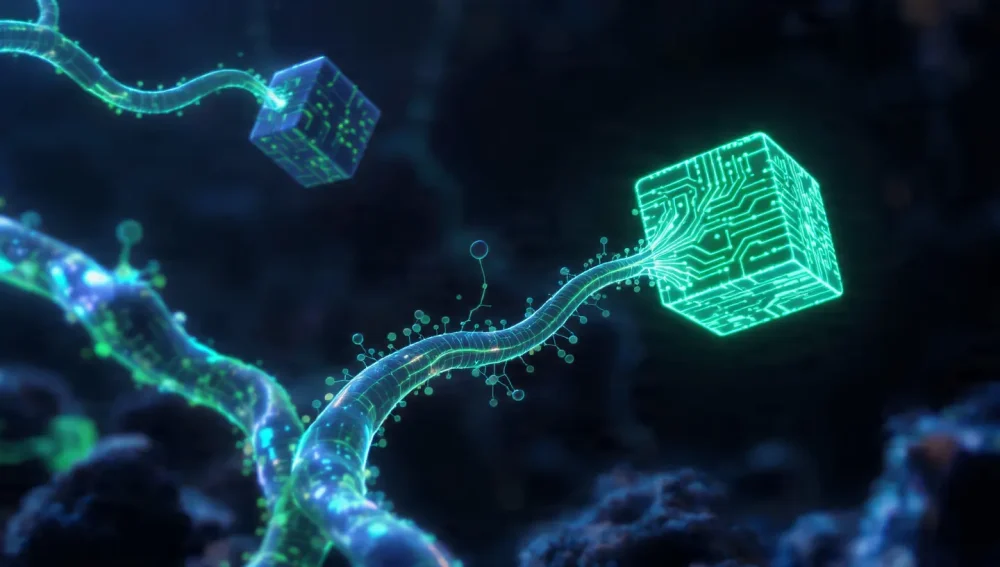
Mycelial Data-Navigation Systems are decentralized, biomimetic information architectures that mimic the non-linear growth patterns of fungal networks. Unlike static Knowledge Graphs, MDNS utilizes “hyphae-nodes”—autonomous data packets that actively seek connections, self-repair broken links, and optimize pathways for AI agents in real-time, creating a living data substrate.
1. The Evolution of Data Topology: From Tables to Forests
To understand why Mycelial Systems are the standard for 2026, we must look at the trajectory of data accessibility.
- 2010s (The Filing Cabinet): SQL and NoSQL. Data was stored in rows, columns, or documents. Retrieval required knowing exactly where to look.
- 2023-2024 (The Vector Era): The rise of RAG (Retrieval-Augmented Generation). Data was converted into embeddings (numbers). “Similarity search” allowed AI to find related concepts, but it lacked deep context or logical reasoning.
- 2026 (The Mycelial Era): Data is no longer retrieved; it is traversed. In an MDNS, data points are not static entries; they are active nodes that “sense” the context of a query and rearrange their relationships dynamically to present the most relevant answer.
Why Vector Databases Failed the Agentic AI Test
By late 2025, it became clear that vector databases suffered from “Semantic Drift.” As AI agents began performing multi-step tasks (e.g., “Analyze the supply chain, contact vendors, and renegotiate contracts”), they needed more than just similarity matches. They needed causality and lineage.
What Is the Impact of Artificial Intelligence on Healthcare?Mycelial systems solve this by treating data relationships as living tissue. If one data node (e.g., a vendor’s credit rating) changes, the network automatically “infects” connected nodes (contracts, risk assessments, shipping logic) with the new context without manual re-indexing.
2. Anatomy of a Mycelial System
An MDNS is composed of three biological analogs translated into code.
A. The Hyphae-Nodes (The Connectors)
In a fungal network, hyphae are the filaments that explore the environment. In MDNS, a Hyphae-Node is a data wrapper containing:
Simpsonizados: A Close Look at the Characters of the Simpsons- The Payload: The raw data (text, image, code).
- The Sensory Script: Lightweight logic that polls neighboring nodes for relevance.
- The Trophic Policy: Rules defining how “nutrient-rich” (valuable) the data is to the current AI goal.
B. The Mycorrhizal Interface (The Exchange)
This is the API layer of 2026. Instead of rigid REST or GraphQL endpoints, the Mycorrhizal Interface uses Pheromone Protocol Messaging (PPM). When an AI agent queries the system, it releases a “signal” (the query intent). Data nodes that resonate with that signal “grow” toward the query, creating a temporary, high-bandwidth pathway for information retrieval.
C. The Fruiting Body (The Insight)
When enough relevant data clusters together, it forms a “Fruiting Body”—a synthesized, immutable snapshot of the answer. Once the AI consumes this insight, the temporary connections dissolve, conserving computational energy.
Table: Traditional vs. Mycelial Architecture
| Feature | Vector Database (2024) | Mycelial System (2026) |
|---|---|---|
| Structure | Fixed Index (HNSW) | Dynamic/Fluid Topology |
| Relationship | Mathematical Distance (Cosine) | Semantic & Causal Necessity |
| Maintenance | Manual Re-indexing | Self-Healing / Auto-Pruning |
| AI Compatibility | LLM Chatbots | Agentic Swarms / LAMs |
| Latency | Low for Read, High for Update | Real-time Adaptive |
3. The Role of Agentic AI in Mycelial Navigation
In 2026, humans rarely query databases directly. We employ AI Agents. MDNS is specifically engineered for these agents.
Web Design for AI Agents: The Ultimate 2026 Guide to Agentic SEOThe “Foraging” Algorithm
Agents in 2026 utilize “Foraging Algorithms” rather than search algorithms.
- Inoculation: The agent enters the data environment with a specific goal.
- Colonization: The agent identifies a “hub node” (a highly connected piece of data).
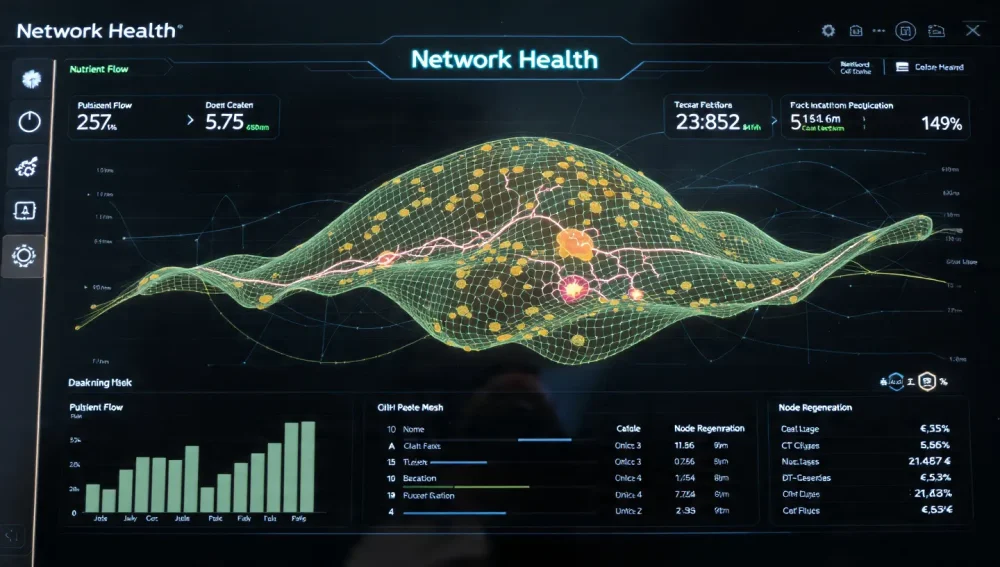
- Nutrient Transport: The agent utilizes the pre-existing hyphae connections to pull related data without having to scan the entire database.
This reduces the “Token Cost” of retrieval by 60% compared to 2024 standards, as the network pre-filters irrelevant data before the agent even sees it.
4. Building the Substrate: Technical Implementation
How do you build a Mycelial Data-Navigation System in 2026? It requires a shift in the technology stack.
Can You Get Rich Off Stocks? Find Out Now!The Rise of Graph-Neural Hybrid Databases
The underlying storage is no longer just Postgres with pgvector. It is likely a Graph-Neural Hybrid (GNH) like Neo4j-X or FungalDB (hypothetical 2026 leaders). These databases allow nodes to hold neural weights that adjust based on how often they are successfully used in a query.
Language Requirements: Mojo and Rust
Python’s latency is too high for the real-time “growth” of data connections. The backend logic of MDNS is almost exclusively written in Mojo (for AI interconnectivity) and Rust (for memory safety in self-replicating nodes).
The “Rot” Protocol (Garbage Collection)
In biology, decay is essential. In MDNS, data that is no longer accurate or useful must “rot.”
- Time-to-Decay (TTD): Unlike Time-to-Live (TTL), TTD is probabilistic. If a node is rarely accessed and contradicts newer nodes, its connection strength weakens until it is archived (composted) into cold storage.
- Hallucination Pruning: If an Agent flags a node as false, the MDNS marks the node as “toxic,” severing its connections to prevent the spread of misinformation to other agents.
5. Use Cases: Who Needs MDNS?
A. Decentralized Science (DeSci)
Pharmaceutical research in 2026 relies on cross-referencing millions of unformatted studies. MDNS allows a “Liver Toxicity” node to automatically grow connections to a “New Compound” node the moment a relevant paper is published, alerting researchers immediately.
B. Autonomous Supply Chain
When a hurricane hits a port in Singapore, a standard database updates a delivery time. An MDNS automatically reroutes the digital twin of the supply chain, identifying alternative vendors (hyphae) that have dormant but viable connections, activating them instantly.
C. Personalized Education Architectures
For a student learning quantum physics, the MDNS arranges the curriculum based on their current “absorption rate.” If the student struggles with a concept, the data topology rearranges itself to present prerequisite nodes (foundational math) before allowing access to advanced nodes.
6. Challenges and Ethical Considerations
The “Overgrowth” Risk
Without strict “enzymatic” limits (governance protocols), a Mycelial system can create too many connections, leading to “Data Bloat” where everything is related to everything, rendering retrieval useless. This is the 2026 equivalent of “Signal-to-Noise ratio.”
Security: The Spore Attack
Hackers in 2026 don’t steal tables; they inject “poison spores”—bad data designed to be picked up by Hyphae-nodes and integrated into the trusted network. Security protocols now involve “Data Immunology,” where AI hunter-killers constantly patrol the mycelium for anomalous growth patterns.
7. Future-Proofing Your Organization
To prepare for the Mycelial shift, organizations in the mid-2020s must:
- Stop Siloing Data: Move toward Data Mesh architectures immediately.
- Adopt Knowledge Graphs: If you aren’t using Graph RAG yet, you are two years behind.
- Train for Semantics: Ensure your data teams understand semantic ontologies, not just SQL schemas.
The organizations that treat their data as a static vault will be outpaced by those who treat their data as a living ecosystem. In 2026, the data doesn’t just sit there; it navigates itself to the user.
FAQ: Mycelial Data-Navigation Systems
A Knowledge Graph is a map; it shows you where things are. A Mycelial System is a traffic system; it actively manages the flow, opens new roads (connections) based on demand, and closes old ones. It is dynamic and agent-centric, whereas Knowledge Graphs are static and query-centric.
Yes. In fact, MDNS is the preferred memory architecture for GPT-5 and post-GPT models. It provides the “Long-Term Actionable Memory” that LLMs lack, allowing them to recall complex relationships over months of interaction.
Surprisingly, yes. While the initial setup is compute-heavy, the retrieval process is highly efficient. Because the network “pre-fetches” relevant associations, the AI agent spends fewer tokens and less GPU power reasoning through irrelevant data.
MDNS utilizes “Cellular Privacy.” Each data node contains its own permission logic. When a user revokes consent, their associated nodes instantly disappear from the network, ensuring their Right to Be Forgotten without complicated database processes.
No. For transactional data (banking ledgers, inventory counts), the rigid structure of SQL remains superior. Mycelial Systems are for unstructured, relational, and semantic data—which constitutes 90% of enterprise value in 2026.