


The era of “Ten Blue Links” is ending. For Enterprise SaaS, where sales cycles are long and purchase decisions are complex, a new battlefield has emerged: Generative Engine Optimization (GEO).
We are witnessing the most significant shift in search behavior since the inception of Google. Decision-makers are no longer just Googling; they are prompting. They are asking ChatGPT, Perplexity, Claude, and Google’s AI Overviews (formerly SGE) to compare software, analyze features, and recommend solutions.
If your SaaS platform is not optimized for these Large Language Models (LLMs) and Retrieval-Augmented Generation (RAG) systems, you are effectively invisible to the modern buyer.
This guide is your blueprint for dominating the “Zero Position” in the age of AI.
What is Generative Engine Optimization (GEO)?
Generative Engine Optimization (GEO) is the strategic process of creating and structuring content to maximize visibility, citation, and recommendation frequency within Generative AI engines and AI-powered search results.Elevate Your Images: 10 Best Free Picture Editing Apps Uncovered
Unlike traditional SEO, which optimizes for a search engine’s ranking algorithm based on backlinks and keywords, GEO optimizes for LLM comprehension. It focuses on ensuring that when an AI “reads” your content, it perceives your brand as the authoritative, statistically backed, and most logical answer to a user’s query.
SEO vs. GEO: The Enterprise Paradigm Shift
To build a winning strategy, you must understand how GEO differs from the SEO strategies you have used for the last decade.
| Feature | Traditional Enterprise SEO | Enterprise GEO |
|---|---|---|
| Primary Goal | Rank #1 in organic search results. | Secure citations and direct recommendations in AI responses. |
| Success Metric | Click-Through Rate (CTR), Organic Traffic. | Share of Model (SoM), Brand Mentions, Sentiment. |
| Content Focus | Keywords, Search Volume, Length. | Context, Proprietary Data, Entity Relationships. |
| Technical Core | Site Speed, Core Web Vitals, H-Tags. | Structured Data, Semantic Clarity, Vector closeness. |
| User Journey | Discovery -> Click -> Land -> Convert. | Query -> Answer -> Verification -> Brand Search. |
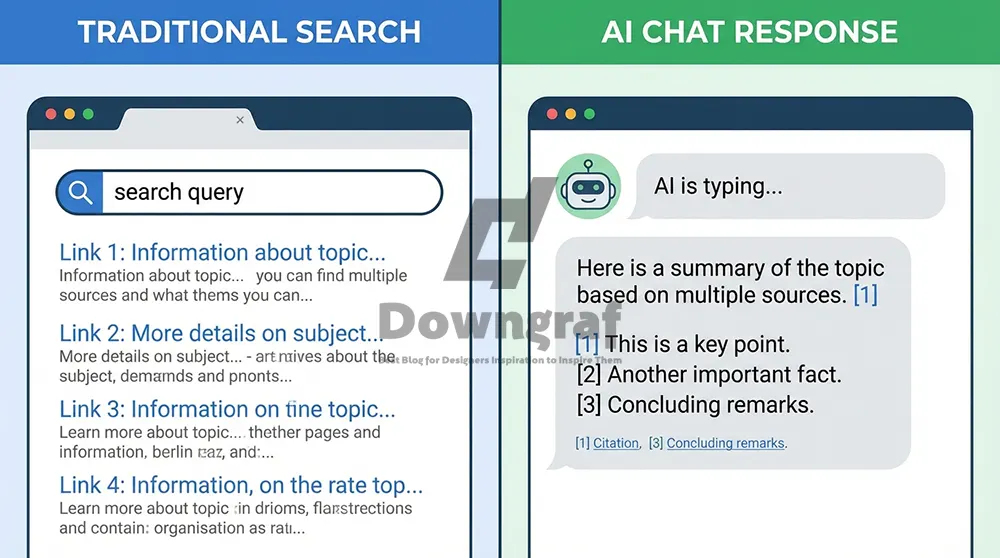
Why Enterprise SaaS Must Pivot to GEO Now
For Enterprise SaaS, the stakes are higher than for any other vertical. Here is why your existing strategy is vulnerable:
- The “Zero-Click” Reality: Gartner predicts that by 2026, search engine volume will drop by 25% due to AI chatbots. Users want answers, not lists of links. If the AI answers the user’s question about “Best CRM for FinTech” without mentioning you, you lose the prospect before they ever visit a website.
- Complexity Suits AI: Enterprise software is complex. Buyers use AI to summarize implementation times, compare API capabilities, and draft RFPs. GEO ensures your technical documentation and white papers are the source material for these summaries.
- Authority is the New PageRank: LLMs favor “high-confidence” sources. In the SaaS world, this means brand authority and data density are weighted heavily.
The 4-Pillar GEO Framework for SaaS
To rank in the Generative Engine, you cannot rely on keyword stuffing. You must optimize for information retrieval.Best Route Optimization Software for Small Courier Business (2026 Guide)
Pillar 1: Citation Authority and Brand Co-occurrence
LLMs operate on probability. They predict the next word or concept based on training data. To be recommended as a solution, your brand name must statistically appear alongside specific problems and solutions.
The Strategy:
- Digital PR & Co-occurrence: Get mentioned in tier-one industry publications (TechCrunch, Gartner, Forrester) alongside your primary category keywords. If you are a cybersecurity tool, you need to be mentioned in articles discussing “Enterprise Ransomware Solutions.”
- The “Expert Consensus” Signal: AI engines often cross-reference multiple sources to verify facts. If five authoritative sources list your SaaS as a top contender, the AI increases its “confidence score” in recommending you.
Pillar 2: Proprietary Data and Statistics
Generic content is the enemy of GEO. LLMs have “read” the entire internet; they do not need another 500-word blog post defining “What is Cloud Computing?”
What they do need—and what they cite most often—is unique data.How to Get to Tech World in Pet Simulator X?
The Strategy:
- Publish Original Research: Release annual “State of the Industry” reports.
- Quote-Worthy Stats: Create content that provides specific numbers.
- Bad: “Our software improves efficiency.”
- Good for GEO: “Enterprises using [Brand] see a 34% reduction in API latency within 90 days.”
- Why this works: When a user asks Perplexity, “What are the efficiency gains of using [Category] software?”, the AI looks for hard numbers to construct a credible answer. If you own the numbers, you own the citation.

Pillar 3: Semantic Structure and Entity Optimization
LLMs do not read; they parse tokens and vectors. They look for relationships between “Entities” (People, Places, Things, Concepts). Your content must be structured to make these relationships obvious.
The Strategy:
- Structured Data (Schema): Go beyond basic Article schema. Use
Product,FAQPage,HowTo, andOrganizationschema. Explicitly link your software (Product) to the problems it solves (about). - Definition Tuples: Start technical articles with clear, encyclopedic definitions.
- Format: “[Concept] is a [Category] that helps [Audience] achieve [Outcome] by [Mechanism].”
- Example: “Headless CMS is a content management system that helps enterprise developers deliver content to any device by decoupling the backend repository from the frontend presentation layer.”
- Contextual Density: Use industry-specific jargon correctly. An article that uses “churn,” “CAC,” and “LTV” correctly in context signals to the LLM that the content is expert-level B2B material, not generic consumer content.
Pillar 4: The “Human” Moat
Ironically, optimizing for robots requires being more human. Google’s E-E-A-T (Experience, Expertise, Authoritativeness, Trustworthiness) is a proxy for quality that LLMs also mimic.What is Frustration-Free Packaging on Amazon?
The Strategy:
- Subject Matter Expert (SME) Interviews: AI can hallucinate facts, but it cannot hallucinate experience. Content featuring quotes like “In my 15 years as a CTO, the biggest mistake I’ve seen is…” performs exceptionally well because it is unique, non-commodity text.
- Opinionated Frameworks: creating a branded methodology (e.g., HubSpot’s “Inbound Marketing”) forces the AI to use your terminology to explain the concept.
Optimizing for Specific Engines
Not all AI engines work the same way. Here is how to tailor your Enterprise SaaS strategy for the big three.
1. Google AI Overviews (SGE)
- Source: Heavily reliant on the Google Search Index.
- Optimization: Focus on traditional SEO fundamentals + Featured Snippet optimization. Direct answers, lists, and schema markup are critical.
- Tactic: Monitor “People Also Ask” boxes for your keywords. Rewrite your FAQ sections to answer these questions more concisely than your competitors.
2. Perplexity AI
- Source: Real-time web crawling with a focus on academic and news sources.
- Optimization: Citation density. Perplexity loves citing reports, white papers, and credible news sites.
- Tactic: ensure your PDF white papers are crawlable (not locked behind hard gates) or have robust HTML summaries. Perplexity reads PDFs very well.
3. ChatGPT (Search Mode) / Bing
- Source: Bing index + massive training data.
- Optimization: conversational fluency.
- Tactic: Write in a natural, conversational tone. Avoid “keywordese.” Use “Natural Language Processing” (NLP) friendly syntax. Connect ideas logically using transition words (Therefore, Conversely, For instance).

Tactical Execution: A 90-Day GEO Sprint
How do you implement this for a SaaS company with thousands of pages? Follow this sprint.
Month 1: Audit and Structure
- Entity Audit: Identify the core “Entities” your brand must be associated with (e.g., “Enterprise ERP,” “Cloud Security”).
- Schema Overhaul: Implement deeply nested JSON-LD schema on all product and solution pages.
- Snippet Optimization: Rewrite the first 150 words of your top 20 traffic-driving pages to be “definition-ready.”
Month 2: Data Injection
- Proprietary Data Campaign: Launch one survey or analyze internal platform data to generate 5-10 unique statistics.
- Update Content: Inject these statistics into your existing high-performing blog posts.
- Press Release: Distribute these stats to tech news outlets to generate citations.
Month 3: The Knowledge Graph
- glossary Creation: Build a comprehensive industry glossary. Define terms clearly and link them to your solution pages.
- Comparison Pages: Create “vs” pages (Your Brand vs. Competitor). Be objective. LLMs penalize overly biased marketing fluff. If you acknowledge where a competitor is strong but highlight where you are better for enterprise, the AI is more likely to trust and cite the comparison.
Measuring GEO Success: Beyond the Rank
You cannot track GEO success with Semrush or Ahrefs alone. You need new metrics.7 Best Agentic AI Platforms for Automating SMB Workflows
1. Share of Model (SoM)
This is the percentage of times your brand is mentioned when a user asks a category-defining prompt.
- Test: Prompt ChatGPT with “What are the top 5 enterprise HRIS tools?” ten times. How many times is your brand listed?
2. Brand Mention Velocity
Use tools like Mention or Brand24 to track the frequency of your brand name appearing across the web. An increase in unstructured mentions correlates with higher visibility in LLMs.
3. Referral Traffic from AI
Check your analytics for referrers like bing.com, perplexity.ai, and chatgpt.com. While the volume may be lower than Google organic, the intent is usually much higher.
FAQ: Common Questions on GEO for SaaS
No, GEO is an evolution of SEO. SEO focuses on the index; GEO focuses on the answer. For the next few years, a hybrid approach is required. You need SEO to get into the index so the AI can find you for GEO.
AI agents cannot fill out forms. If all your best insights are behind a PDF gate, the AI cannot read them. The Solution: Create a “Key Findings” HTML page that summarizes the white paper’s data points and arguments. Allow the AI to read the summary while keeping the full document gated for human lead generation.
Not easily. Unlike keywords, which can be stuffed, AI models look for consensus across the web. You cannot “trick” the model with one page; you must build a web of authority and citations that convinces the model your brand is the leader.
Yes, but differently. High Domain Authority (DA) often correlates with trust. AI models assign higher weights to domains that are historically trustworthy (e.g., .gov, .edu, major news outlets, established brands).
Frequently. AI models (especially those with live web access like Perplexity) prioritize “freshness.” Ensure your statistics are dated (e.g., “State of DevOps 2025”) to signal relevance.
Conclusion
The window to establish your SaaS as a dominant entity in the AI knowledge graph is open, but it is closing fast. The brands that feed the engines with high-quality, structured, data-rich content today will be the ones recommended by the AI assistants of tomorrow.
Stop writing just for clicks. Start writing for answers.