


For small and medium-sized businesses (SMBs), the promise of automation has always been tempered by the complexity of implementation. You either hired expensive developers or wrestled with rigid “if-this-then-that” tools that broke the moment a process changed.
In 2026, we are witnessing a paradigm shift from automation to agency. We are moving beyond tools that wait for your click to agents that can “think,” plan, and execute multi-step workflows autonomously.
This guide isn’t just a list; it is a strategic blueprint for SMB owners, operations managers, and technical leads looking to clone their best employees digitally. We’ve tested and analyzed the market to bring you the 7 best Agentic AI platforms that are reshaping business operations today.
What is an Agentic AI Platform?
An Agentic AI Platform is a software environment that enables businesses to build, deploy, and manage autonomous AI agents. Unlike traditional automation (which follows rigid rules), agentic AI systems use Large Language Models (LLMs) to perceive their environment, reason through complex problems, and make decisions to achieve broad goals. They can adapt to unexpected changes and execute tasks across multiple applications with minimal human oversight.
| Feature | Traditional Automation (e.g., Old Zapier) | Agentic AI (e.g., Zapier Central) |
|---|---|---|
| Trigger | Single, specific event (e.g., “New Email”) | Broad goal (e.g., “Qualify leads”) |
| Flexibility | Rigid; breaks if data changes | Adaptive; understands context |
| Decision Making | None; follows a linear path | High; chooses best tools/steps |
| Setup | Requires mapping every step | Requires defining a goal & tools |
The Selection Criteria: E-E-A-T for SMBs
To select these top 7 platforms, we evaluated them based on three critical factors relevant to SMBs:How to Increase Customer Advocacy through Social Media Listening
- Time-to-Value: How quickly can a non-technical founder set up a working agent?
- Orchestration Capabilities: Can the agents work together or handle multi-step reasoning?
- Cost vs. Scalability: Does the pricing model fit a growing business with tight margins?
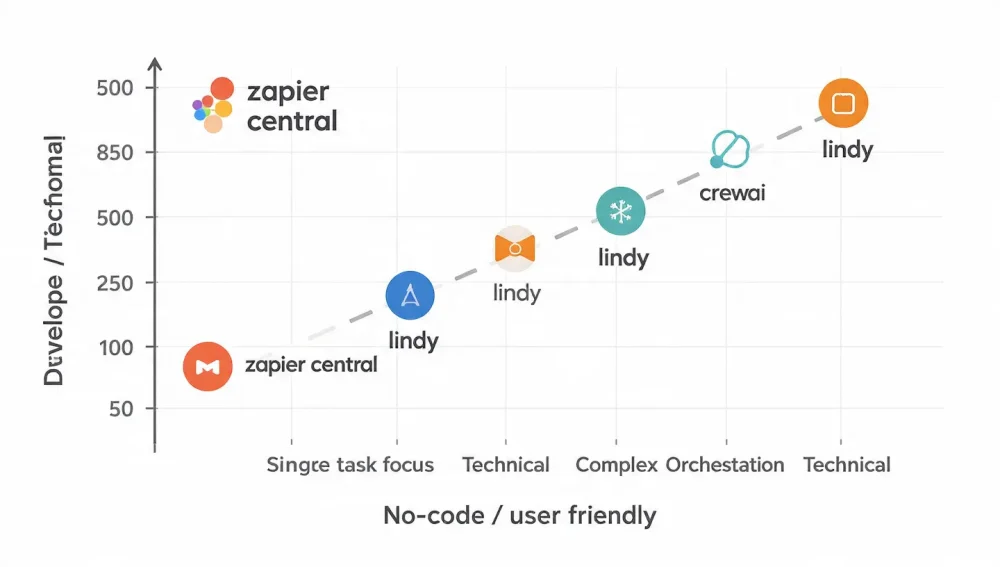
1. Zapier Central
Best For: General Automation & The “No-Code” Crowd
Zapier has long been the glue of the internet, but Zapier Central transforms it from a passive connector into an active brain. It allows you to build AI agents that sit on top of the 6,000+ apps Zapier already integrates with.
Key Features
- Natural Language Logic: You don’t build complex flowcharts. You tell the agent, “When a lead comes in, research them on LinkedIn, and if they are a CEO, draft a personalized email.”
- Live Data Access: Agents can “read” live spreadsheets, Google Docs, or Notion pages to answer questions or make decisions.
- Instant Action: It leverages your existing Zaps but triggers them intelligently based on reasoning.
Pros & Cons
- Pros: unmatched integration library; zero learning curve for existing Zapier users; highly reliable infrastructure.
- Cons: Can get expensive at high volume; reasoning capabilities are slightly less advanced than developer-first tools.
Pricing: Free tier available; Paid plans start around $20/month per member.
SMB Use Case: A boutique marketing agency uses Zapier Central to monitor a “Leads” Google Sheet. The agent autonomously researches the company URL, categorizes the lead as “High Value” or “Low Value,” and pings the Slack channel with a summary only for high-value leads.Elevate Your Images: 10 Best Free Picture Editing Apps Uncovered
2. Lindy.ai
Best For: “Digital Employees” & Pre-Built Roles
Lindy.ai positions itself not just as a tool, but as a staffing solution. They offer “Lindy,” an AI employee that can handle specialized roles right out of the box.
Key Features
- Persona-Based Agents: Select from pre-trained templates like “Medical Scribe,” “HR Recruiter,” or “Executive Assistant.”
- Voice & Meeting Capabilities: Lindy can join your Zoom meetings, take notes, and even speak if required.
- Proactive Work: Unlike a chatbot that waits for a prompt, Lindy can wake up at 9 AM, check your email, and prepare a briefing for you.
Pros & Cons
- Pros: Incredible time-to-value for standard roles; feels like a real teammate; strong voice capabilities.
- Cons: Less flexibility for highly custom, obscure workflows compared to Zapier or CrewAI.
Pricing: Starts at $49/month per agent.

3. Microsoft Copilot Studio
Best For: SMBs in the Microsoft EcosystemWhich Screen Recorder is Best for Gaming?
If your business lives in Teams, Outlook, and SharePoint, Microsoft Copilot Studio is your native agentic solution. It allows you to build custom copilots that are secure, compliant, and deeply integrated into your organizational data.
Key Features
- Graph Grounding: Agents are grounded in your actual business data (SharePoint files, emails) so they don’t hallucinate.
- Security First: Enterprise-grade security and compliance (SOC2, HIPAA ready), which is rare for many AI startups.
- Power Platform Integration: Can trigger Power Automate flows for complex backend actions.
Pros & Cons
- Pros: Best-in-class security; seamless Office 365 integration; familiar interface for Windows users.
- Cons: Can feel clunky if you use non-Microsoft tools (e.g., Slack, Google Drive); steeper learning curve for configuration.
Pricing: Included in certain Microsoft 365 commercial plans; standalone Copilot Studio usually ~$200/month for tenant-level access (2026 pricing estimates vary).
4. Relevance AI
Best For: Multi-Agent Orchestration (B2B Focus)
Relevance AI is a powerhouse for businesses that need teams of agents. It moves beyond single-task agents to “Agent Teams” where a manager agent creates a plan and delegates tasks to researcher or writer agents.What Font Does Google Use? The Definitive, Actionable Breakdown
Key Features
- B2B Orchestration: Define a “Sales Team” where one agent scrapes leads, another enriches data, and a third drafts the outreach.
- Knowledge Retrieval: excellent RAG (Retrieval-Augmented Generation) capabilities to train agents on your specific company PDFs and wikis.
- Low-Code Builder: Visual builder that is more powerful than Zapier but easier than writing Python code.
Pros & Cons
- Pros: Powerful multi-agent capabilities; visual orchestration is intuitive; strong focus on outbound sales and research workflows.
- Cons: Interface can be overwhelming for total beginners; primarily text-based interactions.
Pricing: Free sandbox; Team plans start around $199/month.
5. Bardeen.ai
Best For: Browser-Based Automation & Scraper Agents
Bardeen lives in your browser. It is the ultimate tool for “human-in-the-loop” workflows where you need an agent to scrape data from the web and paste it into your apps while you watch.
Key Features
- Magic Box: Type “Find all LinkedIn profiles for marketing managers in Austin and add them to Notion,” and it builds the automation instantly.
- Deep Scraper: One of the best visual web scrapers on the market, capable of handling pagination and complex sites.
- Context Aware: It knows what tab you are looking at and can act on that specific page context.
Pros & Cons
- Pros: Zero infrastructure setup (runs in Chrome); best-in-class scraping; highly affordable.
- Cons: Since it runs in the browser, it requires your computer to be on for some tasks (though cloud execution is available on higher tiers).
Pricing: Generous free tier; Pro plans start at $15/month.How to Start a Home Decor Business: Easy Steps for Success

6. CrewAI
Best For: Technical Teams & Developers
CrewAI is an open-source framework (with a managed enterprise cloud option) that has taken the developer world by storm. If you have a Python developer on your team, this is the most powerful option on this list.
Key Features
- Role-Playing Framework: You define agents with specific “backstories” (e.g., “You are a grumpy but accurate editor”), which significantly improves output quality.
- Granular Control: Complete control over which LLM (GPT-4, Claude 3, Llama 3) each agent uses.
- Task Delegation: Sophisticated logic for how agents critique each other’s work before finalizing a task.
Pros & Cons
- Pros: Infinite customizability; open-source core (free to use locally); huge community support.
- Cons: Requires coding knowledge (Python); not suitable for non-technical business owners without engineering support.
Pricing: Free (Open Source); Enterprise Cloud starts at $99+/month.
SMB Use Case: A software development shop uses CrewAI to automate code reviews. One agent reads the code commit, another checks for security vulnerabilities, and a third summarizes the changes for the changelog.
7. UiPath Autopilot
Best For: Scaling from SMB to Enterprise
UiPath is the giant of RPA (Robotic Process Automation). Their “Autopilot” brings generative AI to their massive suite. It is perfect for SMBs that anticipate rapid growth and need a platform that won’t cap out.
Key Features
- Clipboard AI: An agent that intelligently copies data from one form and pastes it into another, understanding the semantics (e.g., mapping “First Name” to “Given Name”).
- Text-to-Workflow: Describe a complex finance process in English, and it generates the automation workflow skeleton for you.
- UI Automation: Can click buttons and type in legacy desktop software that doesn’t have an API.
Pros & Cons
- Pros: Can automate anything (even old desktop apps); extreme reliability; enterprise-grade governance.
- Cons: Expensive implementation; steep learning curve; often overkill for very simple tasks.
Pricing: Usage-based, generally starting higher than others on this list, often $400+/month for platform access.
Summary Comparison Table
| Platform | Best For | Tech Level | Pricing Model |
|---|---|---|---|
| Zapier Central | General Automation | Low (No-Code) | Monthly Subscription |
| Lindy.ai | Digital Employees | Low (No-Code) | Per Agent |
| Copilot Studio | Microsoft Users | Medium | User/Tenant License |
| Relevance AI | Sales/Research Teams | Medium (Low-Code) | Team Subscription |
| Bardeen.ai | Web Scraping | Low | Freemium |
| CrewAI | Custom Apps | High (Code) | Free / SaaS |
| UiPath | Legacy/Desktop Apps | High | Enterprise/Usage |
FAQ: Agentic AI for SMBs
For a typical SMB, a budget of $100 – $300 per month can secure a robust setup that does the work of 1-2 full-time interns. The ROI is often realized within the first month.
A chatbot talks; an agent acts. A chatbot can tell you how to reset a password. An agent can log into the admin panel, reset the password, email the temporary one to the user, and close the support ticket—all without you lifting a finger.
For 5 out of the 7 platforms listed here (Zapier, Lindy, Bardeen, Relevance, Copilot), the answer is no. They use natural language interfaces where you simply type what you want the agent to do in plain English.
Most platforms listed (especially Microsoft Copilot and UiPath) act as “processors,” meaning they don’t train their public models on your private data. However, you should always check the “Data Privacy” section of any tool before connecting it to sensitive customer info.
No. Think of Agentic AI as “bionic arms” for your staff. It replaces tasks, not people. It frees your team from data entry, scheduling, and basic research so they can focus on strategy, creative work, and client relationships.