
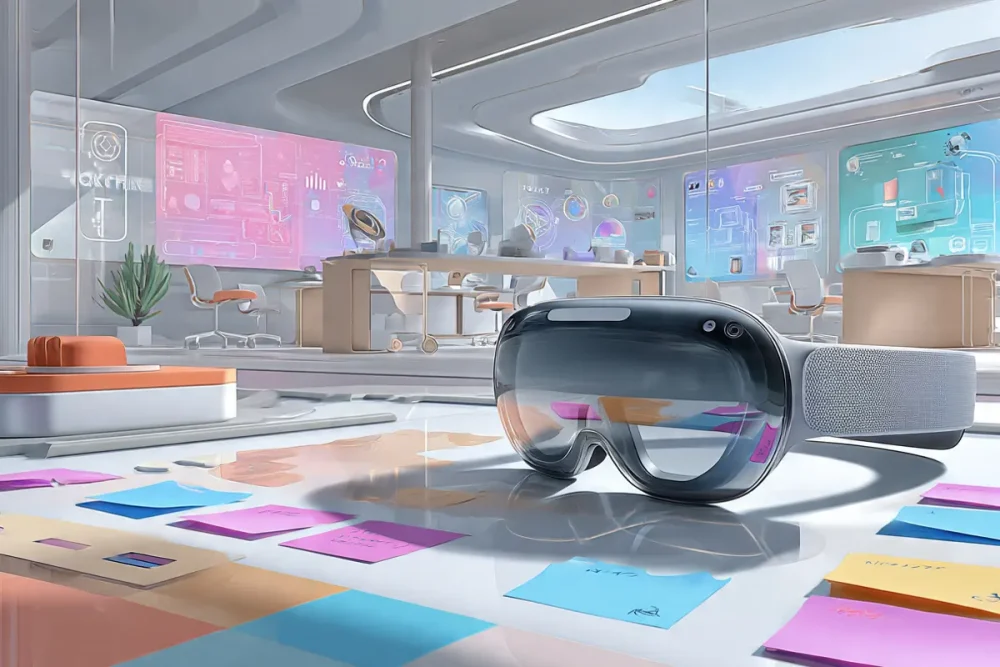
Looks like the flat screen era is behind us, especially for high-performance teams. With Apple dropping the Vision Pro 3, “Spatial Computing” has really come into its own. It’s not just a fun little gadget anymore; it’s something you can actually use every day to get work done. The issues that plagued the first version are gone—say goodbye to that awkward weight that made your neck sore and the tiny field of view. The Vision Pro 3 gives you this endless canvas that mixes right in with your surroundings, opening up a whole new way to work that we couldn’t even do before.
But hardware is only as good as the software driving it. For remote teams scattered across time zones, the “Spatial Canvas”—an unbounded digital workspace—is the new headquarters.
Overview: Our Top 3 Selections for the Spatial Era
If you are looking for the absolute best tools to install immediately, here is the “Zero Position” summary:
| Rank | Tool | Best Use Case | Key Vision Pro 3 Feature |
|---|---|---|---|
| #1 | Freeform X (Enterprise) | Brainstorming & Whiteboarding | Native iCloud sync with infinite distinct canvases. |
| #2 | Microsoft Mesh for Teams | Corporate Meetings & Presence | Realistic avatars with full-body tracking integration. |
| #3 | JigSpace Pro | 3D Visualization & Training | Drag-and-drop CAD viewing with AR pass-through. |
Why “Spatial Canvas” Apps Matter for Remote Teams
Before diving into the list, it is crucial to understand why the shift to Vision Pro 3 matters. Traditional remote work tools (Zoom, Slack) are 2D solutions trying to bridge a 3D human gap. They result in “Zoom Fatigue” because they lack spatial context.
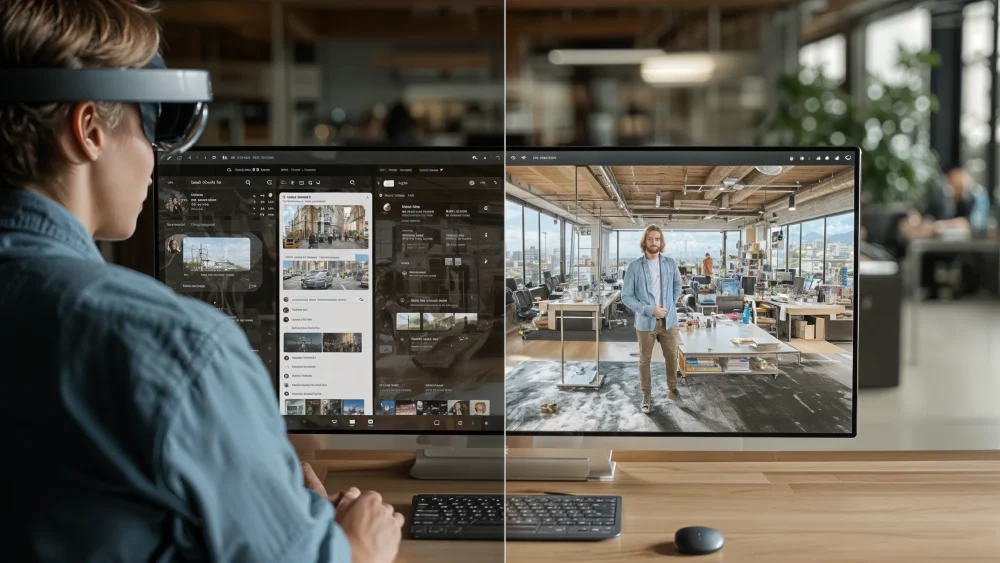
Spatial Canvas tools utilize the Vision Pro 3’s M4X chip and Retina 8K displays to place digital assets in the room with you. This creates a sense of “Co-Presence”—the feeling that you are actually in the room with your colleague, even if they are in London and you are in New York.The Art and Science Behind the Logo Design of a Company
The Top 10 Vision Pro 3 Spatial Productivity Tools
1. Freeform X (Enterprise Edition)
Best For: Creative Ideation and Native Apple Integration
Apple’s native whiteboarding app has evolved significantly. Freeform X takes the “infinite canvas” literally. On the Vision Pro 3, the latency is non-existent. You can use your fingers to pinch, zoom, and rotate sticky notes, images, and documents as if they were physical objects floating in your living room.
- Why it wins: It supports “SharePlay 2.0.” You can look at a colleague’s avatar, pass them a digital sticky note, and they can grab it from your hand.
- Key Feature: “Wall Mode” allows you to project your whiteboard onto a physical wall in your office, turning your real drywall into a touch-sensitive smart surface using the headset’s LIDAR mapping.
2. Miro Spatial
Best For: Agile Workflows and Cross-Platform Teams
While Freeform is great for Apple purists, Miro remains the king of Agile. The Spatial version of Miro wraps your room in Kanban boards. Instead of scrolling horizontally through a timeline, you can walk along it.How is Artificial Intelligence Changing the Recruiting Process Quizlet?
- The Experience: Imagine a Jira ticket that you can pick up and physically move from “In Progress” to “Done.” That is the tactile satisfaction Miro Spatial brings.
- Integration: It syncs perfectly with the desktop version, so team members without headsets aren’t left behind.
3. Microsoft Mesh for Teams
Best For: Immersive Meetings and Corporate Culture
Microsoft has fully integrated Mesh into Teams for the Vision Pro 3. This isn’t just about floating video tiles; it’s about “Immersive Spaces.” You can host a quarterly review in a virtual ski lodge or a digital twin of your actual headquarters.
- Spatial Audio: Voices come from where the avatar is standing. If the CEO is to your right, you hear them from the right. This reduces cognitive load significantly during long meetings.
- Avatar realism: Utilizing the Vision Pro 3’s internal eye and face tracking, your avatar blinks and smiles exactly when you do.
4. JigSpace Pro
Best For: Product Demos and Engineering Review
If your remote team deals with physical products, JigSpace is non-negotiable. It allows you to place high-fidelity 3D CAD models on your desk.15+ LookMovie Alternative That Will Keep You Entertained!
- Use Case: An engineering team can “explode” a jet engine model in mid-air, walk around it, and annotate specific parts.
- AR Overlay: You can overlay a “Jig” (3D instruction) onto a real-world object for remote training. For example, a remote expert can guide a junior technician on how to fix a server rack by highlighting the exact cable to pull in AR.

5. Notion “Infinite”
Best For: Knowledge Management and Database Visualization
Notion has adapted its block-based system for spatial computing. Instead of a flat page, Notion “Infinite” allows you to visualize your databases as 3D clusters.
- Data Visualization: See your project dependencies as a spiderweb of connecting nodes floating above your keyboard.
- Focus Mode: Dim your physical reality (using the Vision Pro’s Digital Crown) and exist solely inside your Notion dashboard for deep writing sessions.
6. ShapesXR
Best For: UI/UX Design and Rapid Prototyping
For design teams, ShapesXR is the standard. It allows you to prototype user interfaces and 3D scenes in real-time.How Much Does TikTok Pay You for 1 Million Views? A Comprehensive Guide to Monetizing Your TikTok Success
- The Workflow: A remote design team can stand inside the app they are building. You can toggle between different “scenes” (app states) instantly.
- The Pitch: When pitching to stakeholders, you don’t send a slide deck; you send a ShapesXR invite code, and they walk through the product pitch immersively.
7. MindNode Spatial
Best For: Complex Brainstorming and Mind Mapping
Mind mapping on a 2D screen runs out of space quickly. MindNode Spatial treats ideas like a galaxy. The central concept sits in the middle of the room, and sub-nodes branch out in 360 degrees.
- Gestures: You can “pull” a node to expand it or “push” it away to archive it.
- Search: Voice search highlights the relevant node instantly, glowing in the 3D space.
8. Zoom Haptic
Best For: Traditional Video Conferencing with a Twist
Zoom isn’t going away, but its Vision Pro 3 app is a massive upgrade. “Zoom Haptic” focuses on screen sharing.How to Send an Email to Multiple Recipients Individually in a Fast and Secure Way?
- Multi-Share: You can see five different screen shares from five different colleagues simultaneously, arranged in a semi-circle around you.
- Background Removal: It uses the Vision Pro’s depth sensors to perfectly cut out your background without the jagged edges of standard webcams, placing you in a professional virtual boardroom.

9. Adobe Substance 3D Modeler
Best For: Creative Professionals and 3D Sculpting
This is for the heavy hitters. Adobe has optimized Substance 3D for the Vision Pro 3’s hand tracking. You can sculpt digital clay with your hands.
- Hybrid Workflow: Switch seamlessly between using a physical mouse/keyboard for precision and your hands for organic shaping.
- Rendering: The M4X chip handles real-time ray tracing, meaning you see the lighting and textures exactly as they will appear in the final render.
10. Box for Vision
Best For: Secure File Management and Previewing
Remote teams need secure access to files. Box offers a spatial file manager where folders are represented as physical boxes or stacks on a shelf.
- Previewing: You can pull a file out of a box and preview it (whether it’s a PDF, a video, or a 3D object) instantly in full scale without downloading it to the device local storage.
Comparison of Features and Pricing
Choosing the right tool depends on your team’s specific needs.
| Tool | Monthly Cost (Est.) | Multi-User Real-Time? | Offline Mode? |
|---|---|---|---|
| Freeform X | Free (w/ iCloud) | Yes | Yes |
| Miro Spatial | $20/user | Yes | Limited |
| MS Mesh | Included in Teams | Yes | No |
| JigSpace | $50+/user | Yes | Yes |
| ShapesXR | $30/user | Yes | Yes |
Hardware Considerations: optimizing the Vision Pro 3
To get the most out of these tools, you need to ensure your hardware setup is optimized for “Spatial Stamina.”
The “Light Seal” Fit
Ensure every team member scans their face properly for the custom Light Seal. Improper fit leads to light leakage, which breaks the immersion of apps like Microsoft Mesh, reducing the psychological effect of co-presence.
Bandwidth Requirements
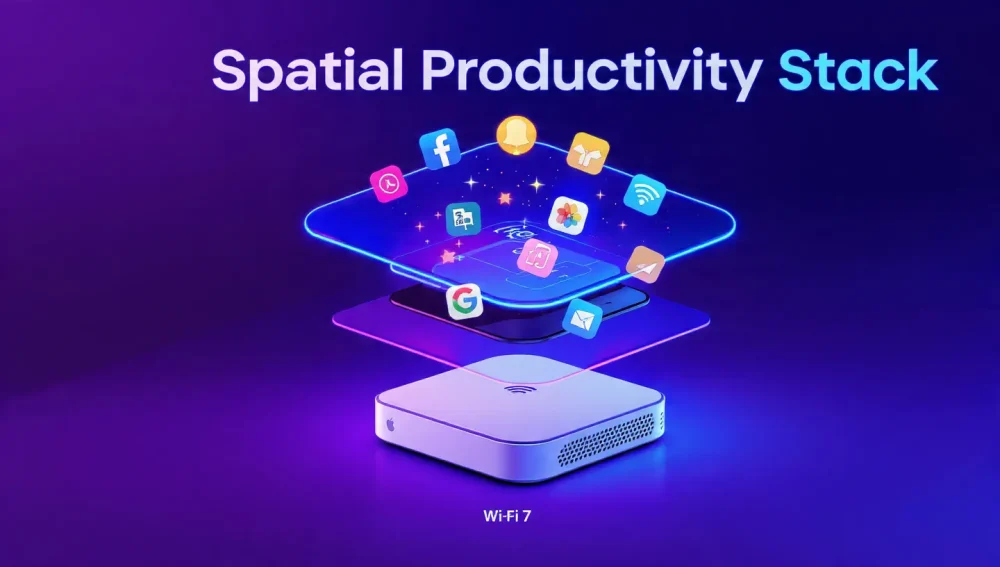
Tools like JigSpace and Adobe Substance stream massive amounts of data. Remote teams need a minimum of 100 Mbps down / 50 Mbps up. Wi-Fi 7 routers are highly recommended to reduce the “motion-to-photon” latency, preventing motion sickness during collaboration.
Implementation Strategy: How to Onboard Your Team
Switching a remote team from Slack/Zoom to a Spatial Canvas workflow requires change management.
- The “Hybrid” Phase: Do not force 100% VR immediately. Start with one meeting a week in Microsoft Mesh.
- The “Artifact” Phase: Encourage the team to leave “Spatial Artifacts.” Leave a Freeform board open in the persistent project room so team members can check it asynchronously.
- The “Deep Work” Phase: Buy licenses for FocusOS or Notion Infinite to encourage solo productivity, proving the device isn’t just for meetings.
Conclusion: The Infinite Office
The Apple Vision Pro 3 has dissolved the physical limitations of the home office. With tools like Freeform X, Miro Spatial, and JigSpace, your desk is no longer 4 feet wide—it is infinite.
For remote teams, this is the missing link. It brings back the spontaneity of the whiteboard session and the clarity of the over-the-shoulder review, all without a plane ticket. The tools listed above are not just apps; they are the building blocks of the future of work.
Start with the free options like Freeform to get a feel for the gestures, then graduate to enterprise suites like Miro or Mesh as your team’s “Spatial Fluency” improves.
Frequently Asked Questions (FAQ)
Yes. The Vision Pro 3 utilizes Optic ID (iris scanning) for biometric authentication. Apps like Box and Microsoft Teams support enterprise-grade encryption (SSO, MDM) ensuring that your spatial data remains within your corporate firewall.
Spatial apps consume significantly more data than standard web apps due to 3D asset streaming. Expect to use 2-3GB per hour for high-fidelity collaboration in apps like JigSpace or Mesh.
Apps like Freeform X and Notion Infinite have robust offline modes that sync once you reconnect. However, collaboration-heavy tools like Microsoft Mesh and Zoom Haptic require an active connection.
Yes. Most tools listed (Miro, Zoom, Teams, Notion) have “Cross-Reality” support. Desktop users will see a 2D window into the 3D space, while headset users will see the full spatial environment.
The Vision Pro 3 features a carbon-fiber chassis that is 40% lighter than Gen 1. However, we recommend the “20-20-20” rule (every 20 minutes, look at something 20 feet away for 20 seconds) and taking the headset off during lunch. Most users find 3-4 hours of continuous use comfortable.